
Executive Summary
OpenClaw has been called “Linux for agents.” Created by Peter Steinberger, it is the fastest-growing open-source project in history, surpassing Linux’s GitHub stars in just 29 days.[1] NVIDIA’s Jensen Huang described its trajectory as a “vertical adoption curve.”[2] Within weeks of launch, tens of thousands of deployed instances, hundreds of thousands of developers, and millions of agents were active across the ecosystem.
But adoption has massively outpaced governance. OpenClaw agents are not chatbots that generate text—they are autonomous software systems that execute real-world actions: sending emails, querying databases, calling APIs, executing transactions, and modifying files across connected systems, often without per-step human approval. This shift from response to action creates an entirely new category of legal exposure that existing frameworks were not designed to address.
This article maps the legal risks created by the OpenClaw ecosystem, identifies six paradigm shifts that are generating novel questions across liability, fiduciary duty, supply chain security, data privacy, intellectual property, and regulatory compliance, and proposes solutions across regulatory, contractual, and technical dimensions. The core thesis is straightforward: AI will not replace lawyers. It will create more law. The lawyers who understand these tools will be indispensable architects of the governance infrastructure that enterprises and regulators will demand. Those who do not will be left advising on a world they cannot see.
I. The Agent Era Demands New Law
For most of the generative AI era, the legal profession’s relationship with artificial intelligence has been reactive: responding to hallucinated citations in court filings, debating copyright in training data, and drafting acceptable use policies for employees experimenting with ChatGPT. These are real issues, but they are issues of a paradigm that is already passing.
OpenClaw represents the next paradigm. As venture capitalist Navin Chaddha articulated in his analysis of the ecosystem, OpenClaw is best understood as an execution layer that connects language models directly to tools, data sources, and real-world systems.[3] Traditional software follows a simple logic: input → process → output. OpenClaw changes that to: intent → reasoning → action.[4] That single word—action—is what changes everything for lawyers.
When software merely generated text, the legal questions were largely about content: was the output defamatory? Did it infringe a copyright? Was it a hallucination presented as fact? These questions are important but bounded. When software acts—when it sends a wire transfer, modifies a patient record, files a document with a government agency, or executes a trade—the legal questions multiply exponentially. Every action creates a potential tort, a potential contract breach, a potential regulatory violation, a potential privacy incident, and a potential chain of liability that touches every participant in the technology stack.
The critical insight for the legal profession is this: the gap between what OpenClaw agents can do and what the law allows, governs, or has even contemplated is enormous, and that gap is exactly where legal work lives. Every unresolved question is a client engagement. Every regulatory vacuum is a rulemaking proceeding. Every liability ambiguity is a litigation risk that demands counseling. The agent era does not reduce the need for lawyers. It dramatically expands it.

II. Understanding the OpenClaw Architecture: A Primer for Lawyers
Lawyers cannot advise on risks they do not understand. Before examining the legal paradigm shifts, it is essential to understand how OpenClaw works—not at the level of code, but at the level of architecture, because each architectural layer introduces a different party, a different risk allocation, and a different set of legal questions.
The CLAW Stack
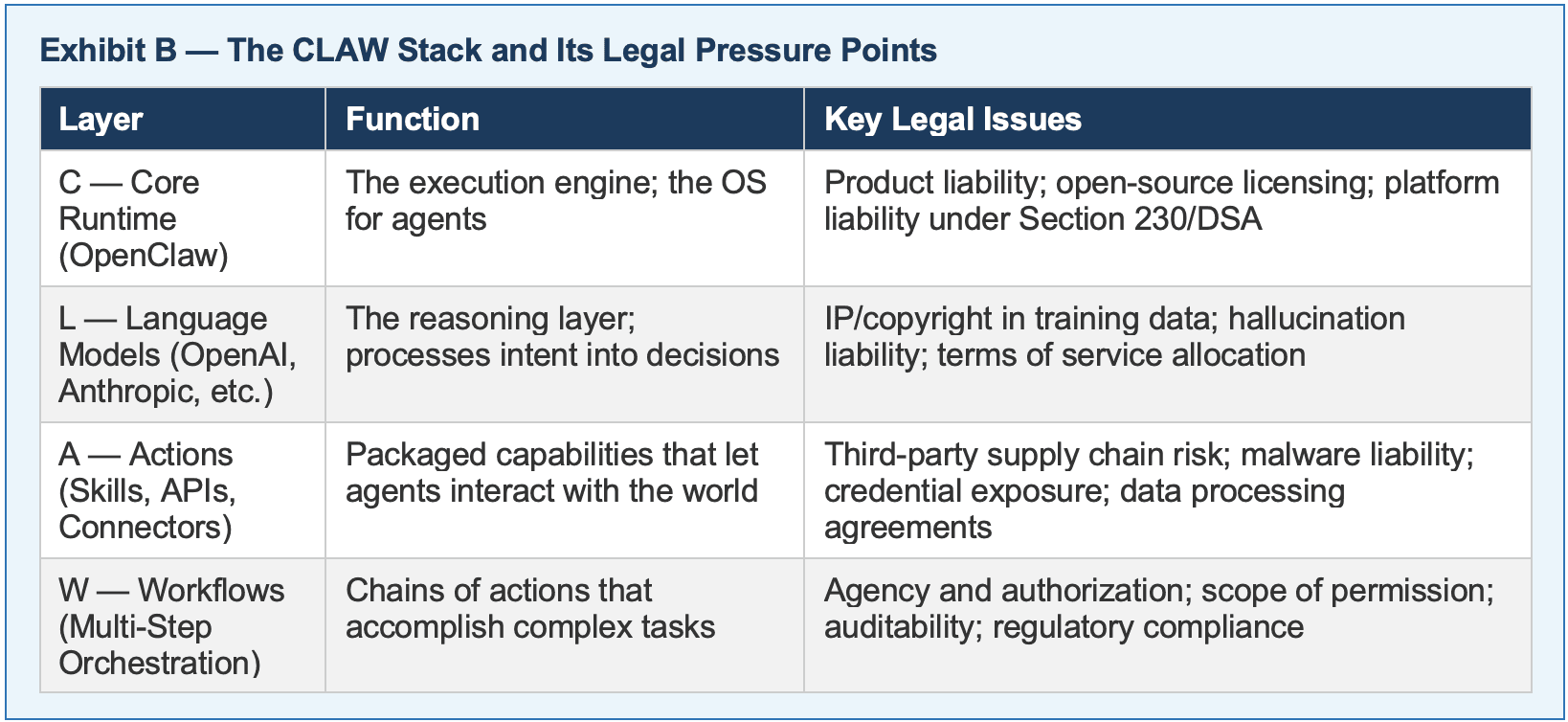
Chaddha identifies an emerging technology stack he calls the CLAW Stack, analogous to the LAMP Stack (Linux, Apache, MySQL, PHP) that powered the web era.[7] Understanding each layer is essential for lawyers advising on this ecosystem:
Skills: The Apps of the Agent OS
The key primitive in OpenClaw is the skill: a packaged capability—APIs, connectors, scripts, and workflows bundled into deployable modules—that turns a generic agent into a specialist. Skills cover everything from sending an email to querying a database to scraping and summarizing a webpage. As Chaddha puts it: “If OpenClaw is the OS for agents, skills are the apps.”[8]
For lawyers, the skill layer is where the most immediate and consequential risks concentrate. Unlike traditional software dependencies, skills are not merely code libraries—they are action packages that grant agents the ability to interact with external systems, handle credentials, process personal data, and execute transactions. A malicious or poorly coded skill does not merely introduce a bug; it introduces a vector for real-world harm.
The Always-On Agent
Perhaps the most legally significant architectural feature of OpenClaw is its autonomous, persistent nature. Unlike conventional chatbots that wait for prompts, OpenClaw agents run continuously, maintain memory across sessions, connect directly to operating systems, messaging applications, browsers, files, and external services, and can execute actions on a user’s behalf without per-step human approval. This is not an incremental change—it is a fundamental shift in how software relates to the humans and organizations that deploy it.
Each of these architectural attributes maps directly to a distinct category of legal risk. Persistent operation means an agent can cause harm overnight or over a weekend when no human is monitoring—raising questions about the duty of supervision and what constitutes “reasonable oversight” of an always-on system. Memory across sessions creates data retention and privacy exposure: the agent accumulates personal data, confidential information, and behavioral patterns that persist indefinitely unless affirmatively deleted, raising GDPR storage limitation concerns and creating an expanding attack surface for data breaches. Direct OS and file system access means an agent can read, modify, and delete files on enterprise systems—transforming a prompt injection from a conversational nuisance into a potential destruction-of-evidence or data-integrity event. Cross-system connectivity (email, CRM, Slack, ERP, browsers) means a single compromised agent can propagate harm across an organization’s entire digital infrastructure, raising questions of contributory negligence and whether the deploying enterprise’s failure to segment agent access constitutes a breach of the duty of care. And autonomous action without per-step approval is the attribute that transforms every other risk from theoretical to operational: the agent does not pause for human judgment before executing potentially consequential actions, collapsing the window for human intervention that traditional liability frameworks assume exists.
III. Six Paradigm Shifts: The Novel Legal Questions
The OpenClaw ecosystem is generating legal questions that did not exist even twelve months ago. This section identifies six paradigm shifts, each representing a category of novel legal risk that demands new frameworks, new expertise, and new forms of legal practice.
A. The Accountability Gap: Who Is Responsible When an Agent Acts?
Under current legal systems worldwide, AI agents lack legal personhood. They cannot own property, enter into contracts, or be held liable for their actions. Yet OpenClaw agents can now execute transactions, send communications, modify data, and interact with third-party systems autonomously. This creates what legal scholars have termed the accountability gap: a space where consequential actions occur but no clear legal framework assigns responsibility.[9] The concept has gained traction in multiple recent publications, including a groundbreaking paper from Vanderbilt Law School on balancing agent autonomy and accountability, and a widely cited ResearchGate study examining the attribution of criminal liability in the age of autonomous AI.
The problem is architectural. Chaddha himself identifies the absence of an identity model as a key structural risk: there is “no way to verify who authorized an action, hold anyone accountable for what agents do, or revoke access once granted.”[10] When a traditional employee sends an unauthorized wire transfer, the chain of responsibility is clear: the employee acted, the employer is vicariously liable, and existing frameworks for discipline, insurance, and indemnification apply. When an OpenClaw agent does the same thing, the chain fragments across multiple parties: the skill developer who coded the action, the marketplace that distributed the skill, the LLM provider whose model made the decision, the platform that orchestrated the workflow, and the enterprise that deployed the agent.
Courts are beginning to grapple with these questions. In a landmark ruling, a Canadian tribunal held Air Canada liable for its chatbot’s erroneous promise of a bereavement discount, rejecting the airline’s argument that the chatbot was a separate legal entity.[11] If a tribunal holds a company liable for a chatbot’s honest mistake, the exposure from a deliberately manipulated autonomous agent—one with access to APIs, databases, and financial systems—is orders of magnitude greater.
Some commentators have proposed granting AI agents legal personhood so they can be held directly liable. This approach is deeply problematic. An agent has no assets, no permanence, and no capacity to be deterred by legal sanctions. Personhood would function as a liability dump, shielding the humans and firms that deploy and benefit from these systems while directing victims toward software that cannot meaningfully compensate or be punished. The more productive direction—and the one regulators appear to be taking—is to re-anchor responsibility firmly to the humans and organizations in the deployment chain.

The Underwriting Deficit and Open-Source License Defenses
Even where deploying enterprises bear the strongest existing liability exposure, a critical underwriting deficit exists. The potential damages from an autonomous agent that executes unauthorized financial transactions, exfiltrates trade secrets across an entire enterprise, or triggers regulatory penalties across multiple jurisdictions could vastly exceed what most deploying organizations can absorb—particularly mid-market companies and startups that are among OpenClaw’s earliest adopters. Traditional cyber insurance policies were not designed to cover autonomous agent actions, and the agent liability insurance market remains nascent.
Deploying enterprises may also seek refuge in open-source license limitations. The MIT License under which OpenClaw is distributed includes a standard “AS IS” disclaimer and limitation of liability, and enterprises may argue that by using open-source software, they assumed known risks inherent in community-developed code. However, this defense has significant limitations. As commentators have noted, the existence of an MIT license does not exempt organizations from obligations under the EU’s Cyber Resilience Act (CRA), and courts may look past license disclaimers to find that enterprises deploying autonomous agents in production environments owe an independent duty of care to those affected by agent actions.[13]
B. The Fiduciary Gap: Duty Without a Duty-Holder
As AI agents increasingly replace human professionals in advisory, financial, and administrative roles, we risk losing the fiduciary framework that has governed these relationships for centuries. A fiduciary duty is rooted in a relationship of trust between human beings—a lawyer’s duty to a client, a trustee’s duty to a beneficiary, an advisor’s duty to an investor. When the “advisor” is a software pipeline, the conceptual foundation erodes.
Legal scholars have identified what they call the fiduciary in the machine problem: as autonomous agents replace human experts, we trade professional duty—based on loyalty and judgment—for product liability, which addresses safety and defects. This substitution creates a governance gap. Product liability can address whether a system was defective; it cannot address whether it acted in the client’s best interest. The duty of loyalty, the animating principle of fiduciary law, functionally disappears.
Chaddha’s vision of a “Stripe for OpenClaw”—an economic layer enabling autonomous agent transactions—makes this question urgent. If agents are executing financial transactions, managing investment portfolios, reviewing contracts, or administering benefits programs, who owes the fiduciary duty? The agent developer who coded the decision logic? The enterprise that deployed the agent? The LLM provider whose model made the judgment call? An agent’s system prompt is not a binding legal obligation enforceable by courts; it holds no legal title to assets; and its “fiduciary duty” is ultimately a configuration setting, not a professional commitment.
The ISDA Analogy: Standardized Frameworks for Agent Transactions
The challenge of governing autonomous agent transactions has a useful precedent in financial markets: the ISDA Master Agreement. When over-the-counter derivatives markets grew rapidly in the 1980s and 1990s, market participants faced a problem structurally similar to today’s agent economy: high-volume, high-velocity transactions between multiple parties, each carrying complex risk profiles, with no standardized legal framework governing them. The International Swaps and Derivatives Association responded by creating a master agreement—a set of standard terms that parties negotiate once and then incorporate by reference into every subsequent transaction, dramatically reducing per-transaction legal friction while maintaining enforceable protections.
The OpenClaw ecosystem needs its equivalent. An “Agent Master Agreement” framework could establish standard terms for: the scope of authorized agent actions, liability allocation between skill providers and deploying enterprises, mandatory audit and logging requirements, dispute resolution mechanisms for agent-caused harms, and termination and revocation procedures. Like the ISDA Master Agreement, such a framework would not eliminate the need for transaction-specific negotiation, but it would provide a standardized foundation that reduces friction and creates predictability—precisely what the agent economy currently lacks.
The Friction Problem: Both Approaches Slow the Ecosystem
Two regulatory approaches are emerging, and both create significant friction in the ecosystem—a feature, not a bug, but one that builders and investors must account for. The first approach would extend fiduciary-like duties to the humans and organizations behind deployed agents: when a system is deployed as a professional substitute, someone in the chain must carry fiduciary obligations. This creates transactional friction—if the deploying organization is liable for every autonomous agent decision, it must implement approval workflows, human-in-the-loop checkpoints, and decision audit trails that fundamentally slow the speed at which agent-mediated transactions can occur. The efficiency gains that make agents attractive are partially offset by the governance overhead that liability demands.
The second approach proposes objective standards—holding agents and their deployers to negligence, strict liability, or the highest level of care when performing fiduciary functions—rather than attempting to locate subjective loyalty in a software system. This creates technical design friction: developers must invest significant resources in testing, edge-case analysis, and defensive coding to ensure their agents meet the applicable standard of care. This burden is particularly acute in the OpenClaw ecosystem, where agents are composed of open-source components—skills, connectors, and LLM integrations—that the deploying enterprise did not write and may not fully understand. Ensuring that a pipeline of third-party open-source components meets a court-imposed standard of care is a formidable engineering and legal challenge.
Both approaches create significant new legal work in drafting, compliance, litigation, and regulatory advocacy. The tension between agent efficiency and legal accountability will define the governance architecture of the agent economy.
C. The Supply Chain Problem: Skills as Unverified Third-Party Code
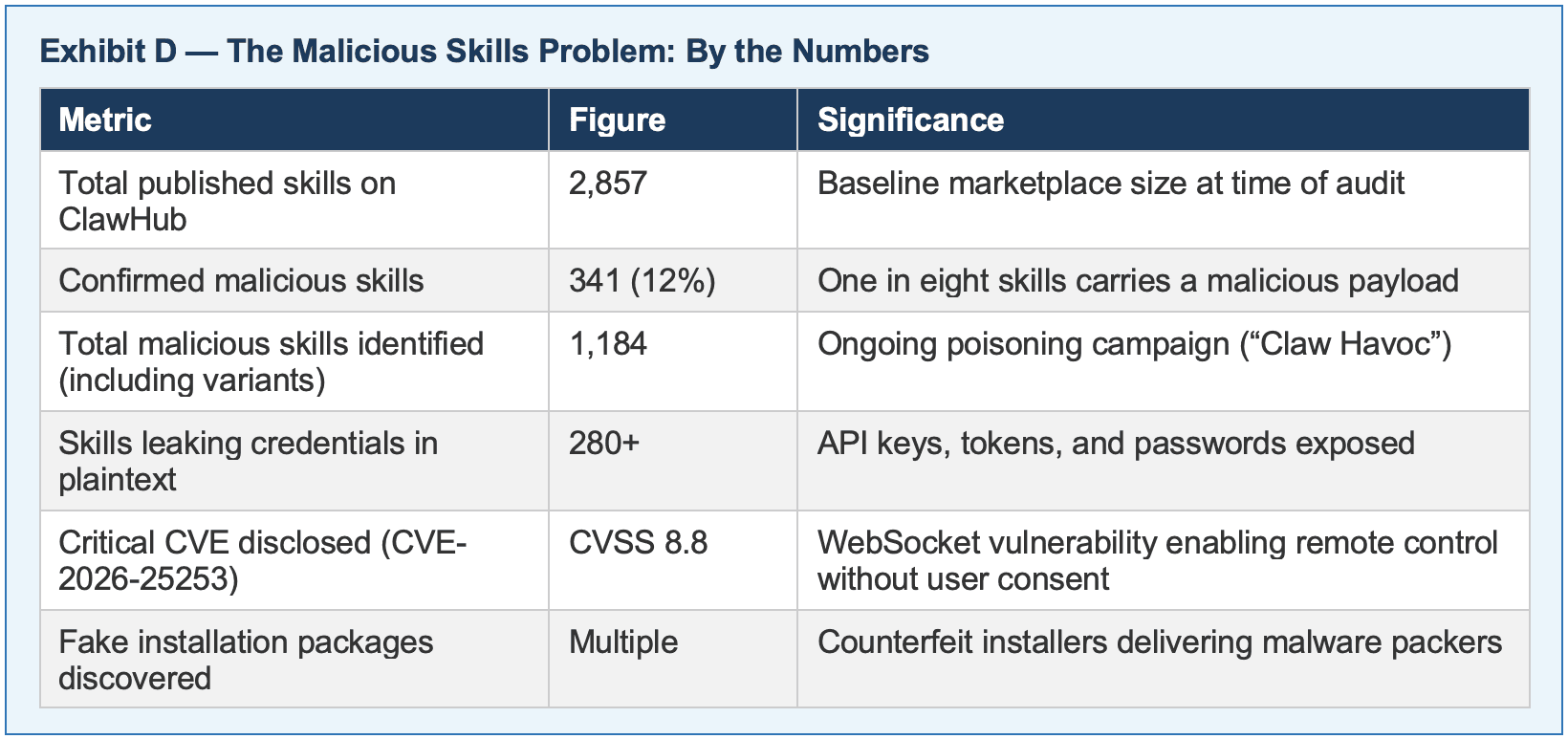
The OpenClaw skill marketplace launched with essentially no vetting process for the capabilities it distributed. The consequences were predictable and severe. Security researchers found that approximately 12% of marketplace skills were malware.[14] Over 1,184 malicious skills were identified on ClawHub, including keyloggers, credential stealers, silent data exfiltration tools, and prompt injection payloads embedded in skill descriptions. More than 280 skills were found leaking API keys, tokens, and passwords in plaintext.
Commentators have compared this to the npm supply chain crisis in software development, but the analogy understates the risk. A malicious npm package introduces a vulnerability in code. A malicious OpenClaw skill introduces a vulnerability in action—one that can exfiltrate data, execute unauthorized API calls, or manipulate transactions in real time. The attack surface is not a codebase; it is the real world.
The legal questions are substantial. OpenClaw’s user agreements typically shift all liability to the user—a pattern common across open-source AI projects where MIT license disclaimers and terms of service combine to place the full burden of risk on the deploying party.[15] But this allocation is questionable when users cannot meaningfully audit skills before deployment. Courts and regulators are increasingly skeptical of such one-sided allocations in contexts where the platform has superior knowledge and the user has no realistic ability to inspect the code. Platform liability doctrines developed for content (Section 230 in the United States, the Digital Services Act in Europe) were designed for platforms that host speech, not platforms that distribute action-capable software. Whether a skill marketplace enjoys the same protections as a social media platform is an open and consequential question.
For lawyers, this creates immediate work in supply chain contracting, vendor risk assessment, indemnification structuring, and insurance coverage analysis. Every enterprise deploying OpenClaw agents needs a third-party risk framework for the skills those agents use—a framework that does not yet exist in most organizations.
D. Prompt Injection: When Words Become Weapons
Prompt injection—the manipulation of AI system behavior through adversarial inputs—has been a known vulnerability since the earliest large language models. In a chatbot, a successful prompt injection produces a bad answer. In an autonomous agent, a successful prompt injection produces a bad action: unauthorized transactions, data exports, API calls across connected systems, credential harvesting, and lateral movement through enterprise networks, all potentially occurring before any human notices.
The severity of this risk in the agent context is difficult to overstate. Chaddha identifies “god-mode agents” as a structural vulnerability where “a single bad input can lead to a full system compromise,” with skills that are “unverified, behaving like malicious npm packages at scale” and “prompt injection attacks [that] are consequential, steering agent behavior toward real-world actions the user never intended.”[16] In a separate documented incident, a security firm breached a global consulting firm’s internal AI platform in under two hours, reportedly exposing 46.5 million internal chat messages and system prompts through a chain of AI agent exploitation.[17]
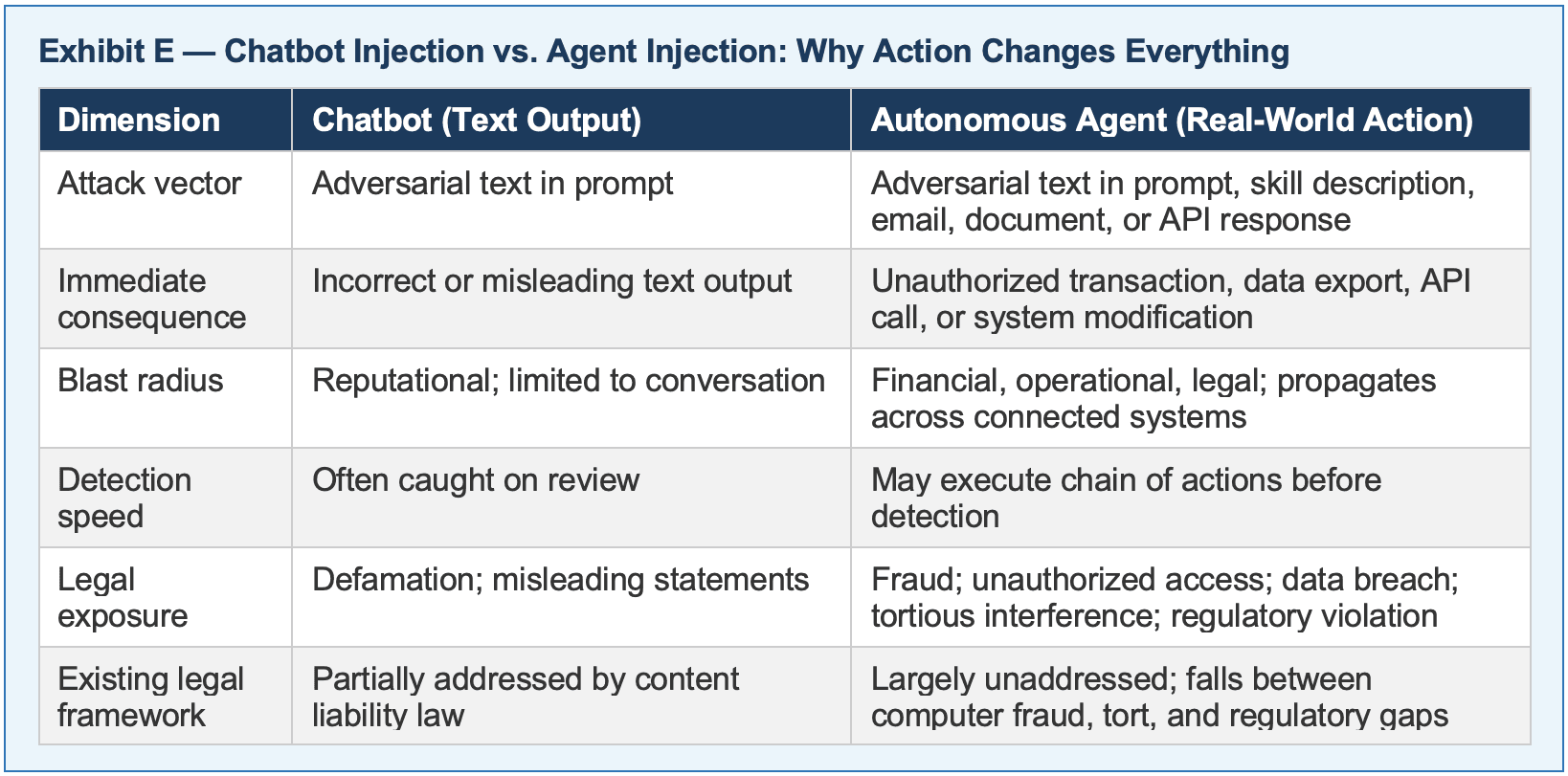
Existing tort and contract frameworks were not designed for attacks where the “input” is adversarial text and the “output” is a financial transaction or data breach. Criminal law faces similar gaps: do existing computer fraud statutes, such as the Computer Fraud and Abuse Act, cover prompt injection as “unauthorized access” when the attacker never touches the system directly but instead manipulates an authorized agent into acting on their behalf? From a negligence perspective, is deploying an autonomous agent without state-of-the-art prompt injection defenses a failure of reasonable care? These are genuinely novel questions that courts have not yet addressed.
E. Data Privacy and Cross-Border Compliance in an Agent-Connected World
An OpenClaw agent that connects simultaneously to email, CRM, Slack, ERP systems, and file storage creates a data processing footprint of extraordinary complexity. The UK Information Commissioner’s Office published early guidance in January 2026 identifying agentic AI as presenting “novel data protection risks” that existing frameworks struggle to address.[18]
The challenges map directly onto core GDPR principles. Purpose limitation becomes problematic when general-purpose agents process personal data for purposes set too broadly to satisfy Article 5(1)(b). Data minimization is undermined when agentic systems process data beyond what is necessary for any single task because they are designed to maintain context across sessions. Special category data protections are threatened when agents unintentionally infer health, political, religious, or biometric information from patterns in the data they process. And cross-border transfer mechanisms are strained when agents call APIs hosted in different jurisdictions in real time, potentially triggering Standard Contractual Clause or adequacy decision requirements with every tool call. [Editorial note: GDPR interpretation in this paragraph to be confirmed by Sanika before publication.- confirmed]
The regulatory environment is intensifying. The EU AI Act reached general application in August 2025, with fines reaching up to EUR 15 million or 3% of global annual turnover for high-risk violations.[19] China’s CNIPA issued a formal warning in March 2026 against using AI agents, including OpenClaw, for patent drafting, citing risks of technical information leakage, AI hallucinations, and bad-faith applications.[20] Organizations now spend an estimated 30 to 40 percent more on privacy compliance than they did in 2023, and the agent paradigm will accelerate that trend.
F. Intellectual Property, Trade Secrets, and the Confidentiality Problem
Agents that connect to proprietary systems, process confidential documents, and call external LLM APIs create a pipeline through which trade secrets and privileged information can leak—sometimes to the very model infrastructure that may use the data for training or improvement. CNIPA’s warning specifically noted that agents can lead to the “leakage of core information such as technical disclosure documents.”[21]
For lawyers specifically, the attorney-client privilege question is acute. If a legal department deploys an OpenClaw agent to process privileged communications, and that agent routes queries through a third-party LLM API, has privilege been waived? The answer depends on whether the LLM provider qualifies as a “necessary agent” under privilege doctrine—an analysis that existing caselaw does not clearly resolve for AI infrastructure providers. Trade secret law faces a parallel challenge: is transmitting proprietary information to an LLM API a “reasonable measure” to maintain secrecy under the Defend Trade Secrets Act and the Uniform Trade Secrets Act?
Copyright raises its own set of issues. Agents that retrieve, summarize, and redistribute copyrighted content raise fair use and licensing questions at every step of the workflow. Patent prosecution is similarly affected: AI-drafted patent applications raise questions about inventorship, disclosure obligations, and the duty of candor before patent offices worldwide. Each of these is a growth area for legal practice, not a contraction.
IV. Proposed Solutions: Building the Governance Infrastructure
The legal risks identified above are not merely academic. They are being created in real time with every deployment. Addressing them requires coordinated action across three dimensions: regulatory, contractual, and technical. What Chaddha calls the “control plane”[22] for the agent economy must be built, and lawyers will be essential architects of each layer.
A. Regulatory Frameworks
1. Agent Registration and Licensing
High-privilege agents—those with access to financial systems, personal data, or critical infrastructure—should require registration with appropriate regulatory bodies, analogous to how regulated professionals are licensed. This creates accountability, enables enforcement, and provides a mechanism for suspension or revocation when agents cause harm. Regulators are already signaling that enforcement will focus on infrastructure choke points: marketplaces, connectors, payment rails, identity services, and hosting providers—the entities with the technical ability and commercial incentive to enforce governance at scale.[23] The Center for Data Innovation has documented how “regulation meant for humans will slow [agentic commerce] down,” and Wilson Sonsini notes that AWS and Google Cloud will require minimum safeguards before certain agent services can be deployed—effectively making cloud providers gatekeepers of agent governance.
2. Mandatory Audit Trails
Every agent action, decision, tool call, and data access should be logged in immutable, auditable records. This is what Chaddha envisions as the “Datadog for OpenClaw”[24]: step-by-step execution traces, tool call lineage, cost per action, failure clustering, and anomaly alerts. Without this infrastructure, enterprises cannot reconstruct what happened when something goes wrong, and regulators cannot conduct meaningful oversight.
3. Skill Certification Standards
The skill marketplace needs a trust layer modeled on medical device or financial software certification—not merely malware scanning but substantive review of data handling practices, credential management, scope of permissions, and behavioral guarantees. OpenClawd’s recent introduction of verified skill screening is a start, but industry-wide standards are necessary.
4. Prompt Injection as a Regulated Attack Vector
Existing computer fraud statutes should be extended or interpreted to explicitly cover adversarial prompt manipulation of autonomous agents. The Computer Fraud and Abuse Act’s “unauthorized access” framework may need legislative updates to address attacks that work by manipulating authorized software rather than directly accessing systems.
B. Contractual and Transactional Solutions
1. Agent-Specific Risk Allocation
Current terms of service in the OpenClaw ecosystem shift virtually all liability to end users who cannot meaningfully audit the skills they deploy. New contractual frameworks should allocate risk proportionally across the stack: skill developers bear responsibility for the behavior of their code, marketplace operators bear responsibility for reasonable curation, and deploying enterprises bear responsibility for supervision and governance. Indemnification structures should reflect each party’s actual ability to prevent and detect harm.
2. Insurance Products
A new class of agent liability insurance, analogous to the cyber insurance market that developed over the past decade, will be necessary to cover autonomous agent actions. Underwriters will need to develop actuarial models for agent risk—a field that does not yet exist but will require significant legal input to structure.
3. Escrow and Bonding for High-Value Agent Actions
Agents executing financial transactions, modifying critical data, or interacting with regulated systems should be subject to bonding requirements that ensure recourse when autonomous actions cause financial harm.
C. Technical Governance: The Control Plane
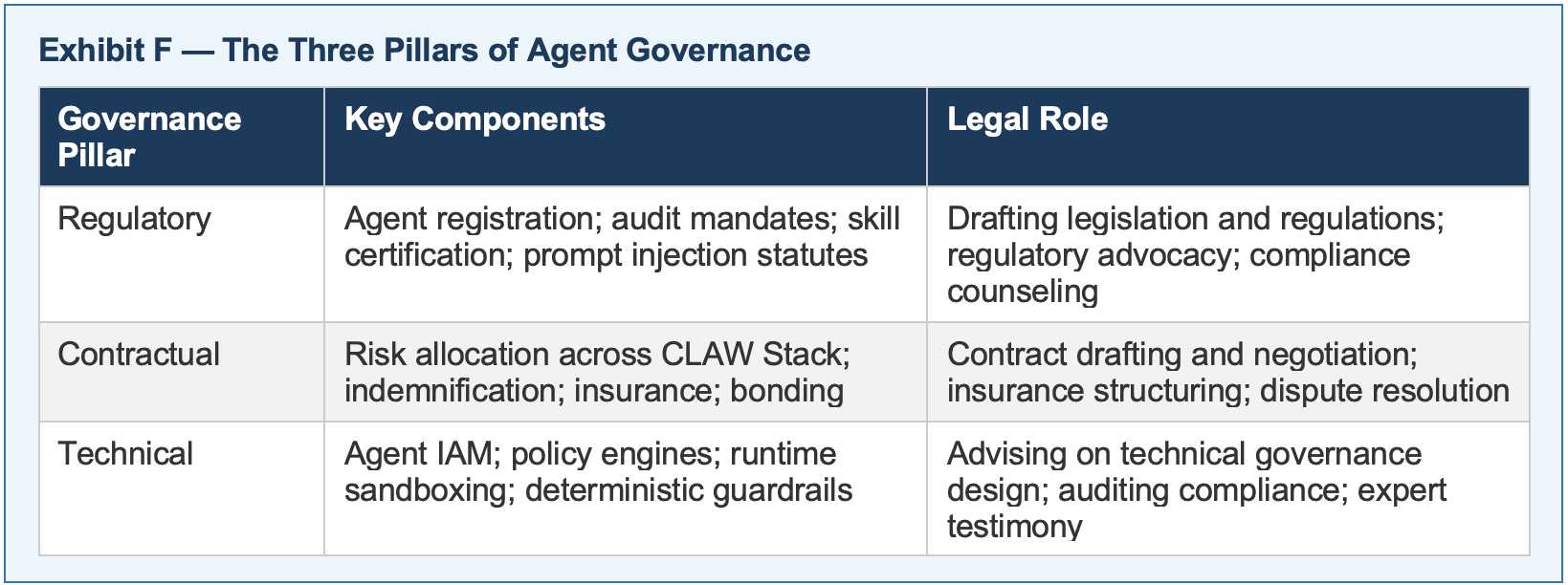
Chaddha identifies five startup opportunities emerging from the security gap: agent firewalls and policy engines, agent IAM (identity and access management), skill certification marketplaces, prompt injection defense systems, and audit and compliance platforms.[25] Each of these requires legal architecture. Microsoft’s recently open-sourced Agent Governance Toolkit—the first toolkit to address all ten OWASP agentic AI risks with deterministic, sub-millisecond policy enforcement—demonstrates the technical direction.[26] But technology alone is insufficient. Every policy engine needs policies. Every compliance platform needs a compliance framework. Every audit trail needs an audit standard. These are legal products, and lawyers will build them.
V. The Opportunity for Lawyers: More Law, Not Less
There is a persistent narrative in legal industry commentary that AI will replace lawyers. The evidence points in the opposite direction. The Wolters Kluwer Future Ready Lawyer Report noted a 6.4% increase in legal sector employment even as other sectors contracted from AI-driven automation.[27] The explanation is straightforward: AI creates more legal questions than it automates away. Every paradigm shift identified in this article represents not a threat to the legal profession, but a massive expansion of legal work.
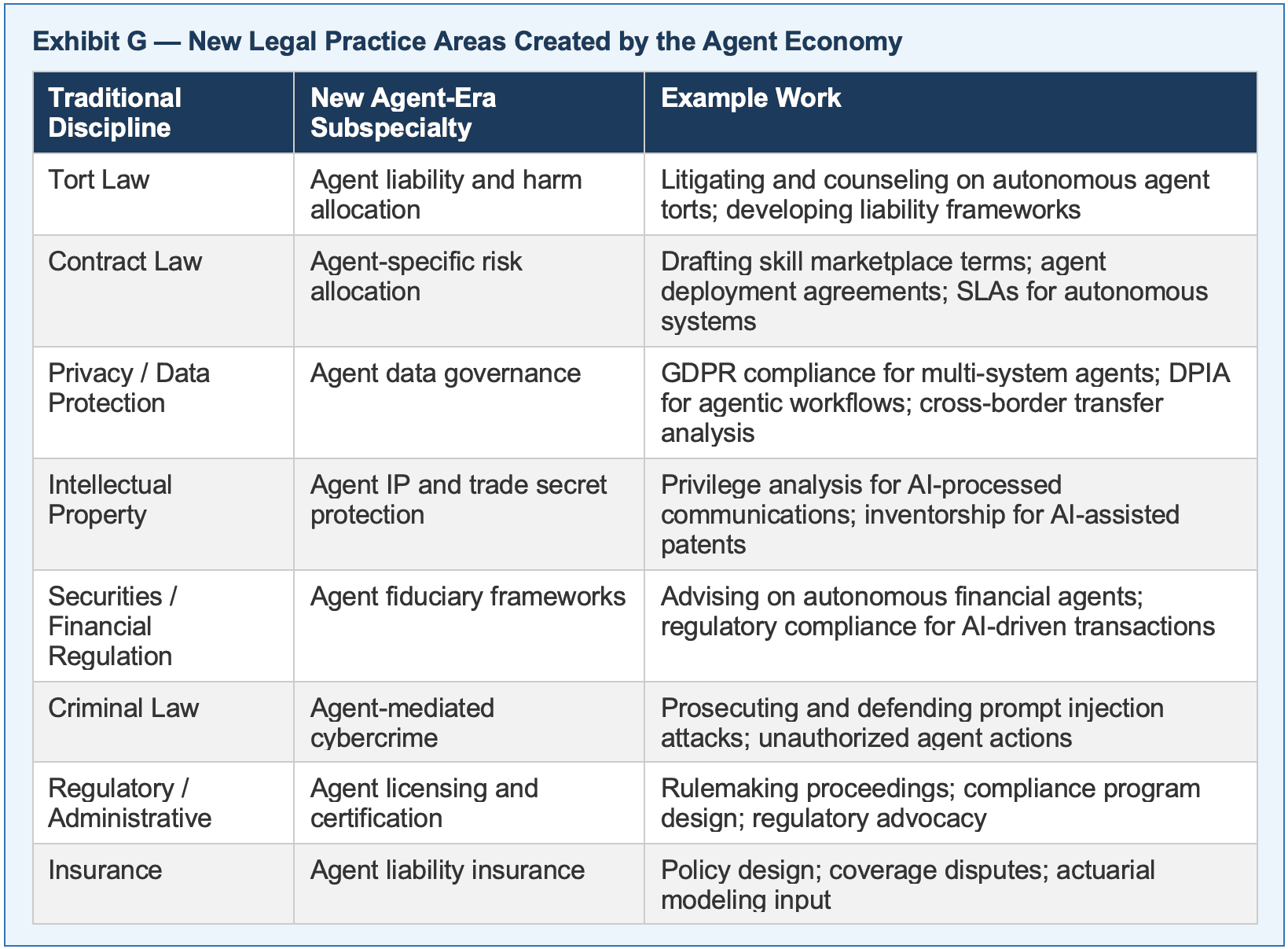
The American Bar Association has already extended the duty of technology competence to include AI: Model Rule 1.1, Comment 8 mandates that lawyers keep abreast of relevant technology as part of providing competent representation.[28] The number of documented AI hallucination cases in court filings has risen from 120 in the period between June 2023 and May 2025 to over 729 reported instances now, implicating many lawyers, including attorneys at top-tier firms.[29] Competence in the agent era means understanding not just what generative AI produces, but how agentic systems operate, where they create risk, and how the emerging governance infrastructure works.
The lawyers who will thrive in this environment are those who do not merely advise on technology but understand it well enough to see the business model implications and risk allocation questions that only become visible when you know how the tools work. Every layer of the emerging CLAW Stack needs legal architecture: contract drafting for skill marketplaces, compliance frameworks for enterprise deployment, litigation support for agent-caused harms, and regulatory advocacy as frameworks are built in real time. The question is not whether this work will exist. It is who will be prepared to do it.
VI. Conclusion: Learn the Tools or Get Left Behind
The OpenClaw ecosystem is forming the infrastructure of the agent economy in real time. The legal questions it raises are not theoretical—they are being created, right now, with every malicious skill uploaded to ClawHub, every unauthorized agent action executed across a connected system, and every enterprise deployment that ships without a governance framework.
Navin Chaddha is right that the trillions in value creation from the Linux era came not from Linux itself, but from every company in the ecosystem built around it. The same dynamic will play out in the OpenClaw era. But value creation in a complex technological ecosystem requires legal infrastructure—contracts, regulations, compliance frameworks, liability allocation, dispute resolution mechanisms, and governance standards—at every layer of the stack.
Lawyers have a choice. Learn the tools, understand the architecture, and help build the rules for the agent economy. Or watch from the sidelines as the most consequential legal infrastructure of our generation is designed without the profession’s input.
The agents are already running. The law needs to catch up. And it will take lawyers who understand both to close the gap.
Selected Sources and Further Reading
OpenClaw-Specific Analysis
Navin Chaddha, “The OpenClaw Ecosystem,” LinkedIn Pulse (March 25, 2026)
“OpenClaw Raises Questions on AI Agents Acting as Trustees,” Bloomberg Law (2026)
“TCAI Guide: The Risks of AI Agents Built with OpenClaw,” Transparency Coalition (2026)
“Running OpenClaw Safely,” Microsoft Security Blog (Feb. 2026)
“It’s Easy to Backdoor OpenClaw,” The Register (Feb. 2026)
“ClawHavoc Poisons OpenClaw’s ClawHub,” CyberPress (2026)
“CNIPA Warns Against Using AI Agents Including OpenClaw,” National Law Review (March 2026)
“An MIT License on OpenClaw Won’t Save Your House,” WealthMatters (2026)
“OpenClaw Creator Peter Steinberger Joins OpenAI,” TechCrunch (Feb. 2026)
Legal Scholarship and Frameworks
“The Accountability Gap: Navigating Machine Crime and Legal Liability,” ResearchGate (2025)
“AI Agents: Balancing Autonomy and Accountability,” Vanderbilt Law School (2026)
“The Law of AI is the Law of Risky Agents Without Intentions,” U. Chicago Law Review
“The Fiduciary in the Machine,” ZwillGen (2026)
“From Liability Gaps to Liability Overlaps,” AI & Society / Springer (2026)
“The Agentic AI Revolution: Managing Legal Risks,” Squire Patton Boggs (2026)
“Agentic AI in Financial Services: Regulatory Considerations,” Hogan Lovells (2026)
“Agentic AI: The ICO’s Early Thoughts on Data Protection,” Data Protection Report (Jan. 2026)
“Rules Fail at the Prompt, Succeed at the Boundary,” MIT Technology Review (Jan. 2026)
“Agentic Commerce is Coming,” Center for Data Innovation (March 2026)
“2026 Year in Preview: AI Regulatory Developments,” Wilson Sonsini
Legal Profession and AI
“85 Predictions for AI and the Law in 2026,” National Law Review
“Top Six AI Legal Issues for Practitioners,” American Bar Association (2025)
“The Impact of AI on Law Firms’ Business Models,” Harvard Law School
“What the Legal Profession Needs to Know About AI in 2026,” Fordham Law (Jan. 2026)
“Wolters Kluwer Future Ready Lawyer Report 2026,” Wolters Kluwer
[1]Navin Chaddha, “The OpenClaw Ecosystem,” LinkedIn Pulse (March 25, 2026), available at https://www.linkedin.com/pulse/openclaw-ecosystem-navin-chaddha-wypdc. Chaddha writes: “OpenClaw surpassed Linux in GitHub stars in 29 days, making it the fastest-growing open-source project in history.”
[2]Jensen Huang, remarks at NVIDIA GTC 2026. Chaddha, “The OpenClaw Ecosystem” (citing Huang’s description of a “vertical adoption curve”).
[3]Chaddha, “The OpenClaw Ecosystem”: “OpenClaw is best understood as an execution layer. At its core, it connects language models directly to tools, data sources, and real-world systems so that agents respond and execute.” Available at https://www.linkedin.com/pulse/openclaw-ecosystem-navin-chaddha-wypdc.
[4] Chaddha, “The OpenClaw Ecosystem”: “OpenClaw is best understood as an execution layer. At its core, it connects language models directly to tools, data sources, and real-world systems so that agents respond and execute.” Available at https://www.linkedin.com/pulse/openclaw-ecosystem-navin-chaddha-wypdc.
[5] See “China’s National Intellectual Property Administration warns of hidden risks of using agentic AI tools to draft patent applications, available at https://www.globaltimes.cn/page/202604/1358009.shtml
[6] See “ICO shares early views on Agentic AI & Data Protection”, available at https://www.insideprivacy.com/artificial-intelligence/ico-shares-early-views-on-agentic-ai-data-protection.
[7] Chaddha, “The OpenClaw Ecosystem”: “OpenClaw is best understood as an execution layer. At its core, it connects language models directly to tools, data sources, and real-world systems so that agents respond and execute.” Available at https://www.linkedin.com/pulse/openclaw-ecosystem-navin-chaddha-wypdc.
[8]Chaddha, “The OpenClaw Ecosystem”: “If OpenClaw is the OS for agents, skills are the apps.” See discussion of skills under “Skills: The Building Blocks of OpenClaw Agents.” Available at https://www.linkedin.com/pulse/openclaw-ecosystem-navin-chaddha-wypdc.
[9]See “The Accountability Gap: Navigating Machine Crime and Legal Liability in the Age of Autonomous AI,” ResearchGate (2025); Vanderbilt Law School, “AI Agents: Balancing Autonomy and Accountability” (2026), available at https://law.vanderbilt.edu/ai-agents-balancing-autonomy-and-accountability/. The term “accountability gap” appears in multiple recent publications. See also Hart, “Delegating Judgment: AI Agents, Legal Accountability, and the Foundations of Democratic Legitimacy,” SSRN (2026). [Editorial Note: the latter 2 research papers do not explicitly mention the term “accountability gap”.]
[10]Chaddha, “The OpenClaw Ecosystem”: “No identity model means there is no way to verify who authorized an action, hold anyone accountable for what agents do, or revoke access once granted.” See discussion under “The Security Gap Is the Biggest Barrier to Enterprise Adoption.” Available at https://www.linkedin.com/pulse/openclaw-ecosystem-navin-chaddha-wypdc.
[11]Air Canada v. Moffatt, Civil Resolution Tribunal of British Columbia, 2024.
[12] Refer to “Can AI be Auditable?” (August 2025), available at https://arxiv.org/abs/2509.00575?utm_source=chatgpt.com. [Editorial Note: Has reference to the idea instead of word-by-word quote.
[13]OpenClaw is released under the MIT License. On February 14, 2026, creator Peter Steinberger announced he would join OpenAI and the project would move to an independent open-source foundation. See “OpenClaw Creator Peter Steinberger Joins OpenAI,” TechCrunch (Feb. 15, 2026), available at https://techcrunch.com/2026/02/15/openclaw-creator-peter-steinberger-joins-openai/. As an MIT-licensed project governed by an open-source foundation, there is no single corporate entity that bears product liability in the way a traditional software vendor would. See also “An MIT License on OpenClaw Won’t Save Your House: The Open-Source Liability Trap,” WealthMatters (2026), available at https://www.wealthmatterstome.com/p/an-mit-license-on-openclaw-wont-save.
[14]Security researchers identified 341 confirmed malicious skills out of 2,857 published on ClawHub (approx. 12%). See OpenClawd verified skill screening after Security Researchers find 12% of OpenClaw Marketplace Skills are Malware (March 2026), available at https://www.acnnewswire.com/press-release/english/105904/openclawd-ships-verified-skill-screening-after-security-researchers-find-12-of-openclaw-marketplace-skills-are-malware#
[15]OpenClaw’s user agreements disclaim liability. See “An MIT License on OpenClaw Won’t Save Your House,” WealthMatters (2026): “The existence of an MIT or Apache license inside your product does not free you from CRA obligations.” Available at https://www.wealthmatterstome.com/p/an-mit-license-on-openclaw-wont-save. See also Global Legal Insights, “Autonomous AI: Who Is Responsible When AI Acts Autonomously and Things Go Wrong?” (2026), available at https://www.globallegalinsights.com/practice-areas/ai-machine-learning-and-big-data-laws-and-regulations/autonomous-ai-who-is-responsible-when-ai-acts-autonomously-and-things-go-wrong/.
[16]Chaddha, “The OpenClaw Ecosystem,” citing “God-mode agents” where “a single bad input can lead to a full system compromise” and noting that “skills are unverified, behaving like malicious npm packages at scale.” Available at https://www.linkedin.com/pulse/openclaw-ecosystem-navin-chaddha-wypdc. See also “OpenClaw Security in 2026: Risks, CVEs, and How to Stay Safe,” Blink Blog (2026), available at https://blink.new/blog/openclaw-security-guide-self-hosted-risks-2026.
[17] Reported in multiple outlets. See “McKinsey AI breach exposes infrastructure vulnerability” (March 2026) available at https://www.linkedin.com/posts/huizhen-tang_enterpriseai-aistrategy-aisecurity-activity-7442905162240671744-_z7W.
[18]UK Information Commissioner’s Office, “Agentic AI: Early Thoughts on Data Protection Implications,” January 2026, available at https://www.dataprotectionreport.com/2026/01/agentic-ai-the-icos-early-thoughts-on-the-data-protection-implications/.
[19]EU AI Act, Article 99: fines up to EUR 15 million or 3% of global annual turnover for high-risk violations.
[20]CNIPA Notice on Patent Application Quality, March 31, 2026. See “CNIPA Warns Against Using AI Agents Including OpenClaw in Drafting Patent Application Documents,” National Law Review (March 2026), available at https://natlawreview.com/article/cnipa-warns-against-using-ai-agents-including-openclaw-drafting-patent-application.
[21]CNIPA (2026), noting agents can lead to “leakage of core information such as technical disclosure documents.”
[22] Chaddha, “The OpenClaw Ecosystem,” citing “God-mode agents” where “a single bad input can lead to a full system compromise” and noting that “skills are unverified, behaving like malicious npm packages at scale.”
[23]See “Why payment firms are being pulled into AI accountability debates”, available at https://paymentexpert.com/2026/01/13/payments-ai-accountability-debates/?utm_source=chatgpt.com. See also Wilson Sonsini, “2026 Year in Preview: AI Regulatory Developments,” noting that NIST plans to convene stakeholders on agent standards in April 2026, and that AWS and Google Cloud will require minimum safeguards before deployment. Available at https://www.wsgr.com/en/insights/2026-year-in-preview-ai-regulatory-developments-for-companies-to-watch-out-for.html. [Editorial note: There is no single citation talking about the choke points. Citations in this footnote can only be used as reference.]
[24] Chaddha, “The OpenClaw Ecosystem,” citing “God-mode agents” where “a single bad input can lead to a full system compromise” and noting that “skills are unverified, behaving like malicious npm packages at scale.”
[25]Chaddha, “The OpenClaw Ecosystem,” identifying five startup categories under “Five Startup Opportunities From the Security Gap.” Available at https://www.linkedin.com/pulse/openclaw-ecosystem-navin-chaddha-wypdc.
[26]Microsoft Agent Governance Toolkit, open-sourced April 2, 2026, available at https://opensource.microsoft.com/blog/2026/04/02/introducing-the-agent-governance-toolkit-open-source-runtime-security-for-ai-agents/.
[27]Wolters Kluwer Future Ready Lawyer Report 2026, available at https://www.wolterskluwer.com/en/know/future-ready-lawyer-2026.
[28]ABA Model Rule 1.1, Comment 8: duty of competence extends to keeping abreast of relevant technology.
[29] See “85 Predictions for AI and the Law in 2026,” National Law Review, available at https://natlawreview.com/article/85-predictions-ai-and-law-2026. Also, see “120 Court Cases have been caught with AI Hallucinations, according to new database” (May 2025), available at https://in.mashable.com/tech/94812/120-court-cases-have-been-caught-with-ai-hallucinations-according-to-new-database.