
Executive thesis. Americans spend $5.3 trillion a year on healthcare. They sit on $20 trillion-plus in commercial real estate. They navigate a $350 billion legal services market in which 92% of low-income civil legal needs go unmet. They rely on a financial advisory industry managing tens of trillions in assets, yet roughly 60% of adults have no advisor at all. Add mental health, education, and the residential and public infrastructure backlog ($3.7 trillion in deferred investment by American Society of Civil Engineers' (ASCE’s) count), and the sectors this memo covers represent well over $30 trillion in annual economic activity and asset value, nearly all of it still running on fragmented data, manual processes, and expert labor that cannot scale to meet demand.
The next decade of durable venture returns will not come from companies that generate new data or train larger foundation models. It will come from companies that stitch together the data sources that already exist, wearables, electronic records, behavioral signals, geospatial feeds, drone captures, financial systems, genomic profiles, and build algorithmic intelligence on top to deliver expert-level services at population scale. The pattern repeats across every sector: essential, expensive, and inaccessible. AI data fusion is the mechanism that breaks that structural barrier. It creates more professional jobs (not fewer), elevates practitioners from data gatherers to strategic decision-makers, and opens addressable markets that billable-hour economics and manual inspection could never reach. For investors, the question is not whether these markets will be transformed, the capital flows, adoption curves, and regulatory frameworks are already forming. The question is who will build the fusion layer, and whether the capital backing them has the patience to collect the returns.
Important notice: not investment advice. This memo is prepared by Ajay Mago in his capacity at Twelvefold Ventures and is intended for informational and discussion purposes only. It does not constitute investment, legal, tax, or financial advice, an offer or solicitation to buy or sell any security or interest in any fund, or a recommendation of any particular investment. Statements about market size, adoption rates, returns, and future performance are forward-looking, may reflect the author’s views and assumptions, and are subject to change without notice. Third-party data is cited in footnotes and has not been independently verified beyond the sources referenced. Readers should consult their own advisors before making any investment decision. Ajay Mago and/or Twelvefold Ventures may hold positions in companies referenced herein; see disclosure at footnote 18.
I. The Stitching Opportunity
For the last three to four years, the dominant narrative in AI investment has been about generation, larger models, more parameters, more synthetic capability. That narrative is now mature, crowded, and capital-saturated. The next wave of durable value creation will be won by the companies that stitch together the data sources that already exist and build algorithmic intelligence on top to deliver expert-level services at population scale.
The raw ingredients are already in the hands of consumers and institutions. An Oura Ring on the finger collects continuous HRV (Heart Rate Variability), sleep architecture, and temperature data. A Dexcom CGM (Continuous Glucose Monitoring) on the arm streams glucose every five minutes. A Meta Ray-Ban captures visual context. An Epic EHR (Electronic Health Record) holds two decades of clinical history. A Plaid feed exposes every transaction. A Khan Academy log records every keystroke a student makes. Each of these streams is interesting. None of them, on its own, is transformative.
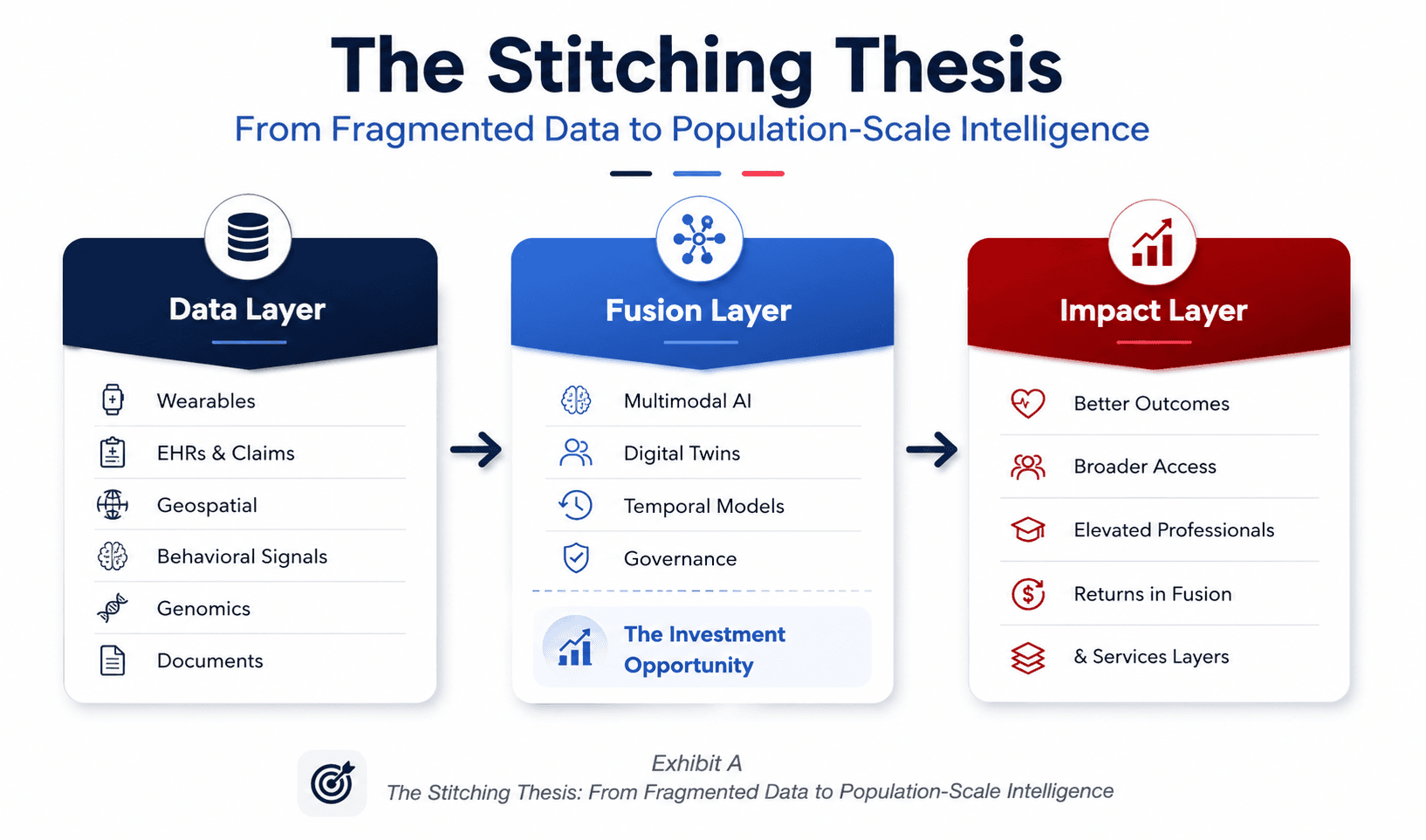
The transformation happens at the fusion layer, the algorithmic middleware that stitches these streams together, identifies multimodal patterns no single sensor could see, and delivers actionable intelligence to human professionals who remain at the center of consequential decisions.
The market is already signaling this shift. The global wearable AI market stood at roughly $43.64 billion in 2025 and is projected to reach $310.56 billion by 2033, a 27.83% CAGR (Compound Annual Growth Rate)[1] per Grand View Research, but that figure captures only the hardware layer. Bessemer’s State of Health AI 2026 report shows that 55% of all health tech funding now flows to AI (up from 37% in 2024 and 29% in 2022), with roughly $14 billion deployed across ~527 deals and a 42% jump in average round sizes to $29.3M.[2] Per Bessemer, six health tech companies, Waystar, Tempus AI, Hinge Health, Omada Health, Caris Life Sciences, and HeartFlow, completed public listings in 2024–25, collectively representing 30% of the $121 billion market cap of actively traded health tech companies. Each is at its core a stitching company.[3]
II. The Structural Pattern: Essential, Expensive, Inaccessible
The industries where the stitching thesis will deliver the largest returns, from professional services to the physical built environment, share five structural characteristics:
1. Essential to human welfare. Healthcare, legal representation, mental health, financial guidance, education, and safe buildings and infrastructure are not discretionary. Demand is non-cyclical, politically protected, and universal.
2. Dependent on scarce, expensive human expertise. Each industry is anchored by credentialed professionals whose training is long and whose time is finite, from physicians and attorneys to structural engineers and certified inspectors.
3. Locked into 1:1 delivery. The professional sees the client, the doctor sees the patient, the lawyer drafts for the one deal in front of her, the inspector climbs the one roof in front of him. This is the structural supply constraint.
4. Data-rich but insight-poor. Each industry sits on oceans of data that are siloed, unstructured, and largely underutilized for decision-making. A commercial building generates thermal, visual, geospatial, and environmental data that no one stitches together.
5. Inequitably distributed. Wealthier populations receive better service and better-maintained buildings. Lower-income populations receive inadequate service or deferred maintenance. The gap is not a bug; it is a direct consequence of characteristics 2 and 3.
The numbers make the structural problem concrete:

III. The Data Stitching Playbook
The technical architecture of the stitching thesis is consistent across sectors. It resolves into three layers.
A. The Sensing Layer
New data-gathering tools are creating continuous, passive data streams where we previously had episodic snapshots. The sensing layer includes consumer wearables (Oura, Apple Watch, Whoop, Dexcom, Abbott Libre); emerging multi-biomarker platforms such as Trinity Biotech’s CGM+[4] and Adaptyx’s multi-biomarker patch[5]; smart glasses (Meta Ray-Ban, Xreal); environmental sensors; and behavioral sensors (keystroke cadence, voice patterns, gait analysis, facial microexpression detection).
The sensing layer on its own is commoditizing quickly. Hardware margins will compress. This is not where the durable returns live, though it is a necessary substrate.
B. The Fusion Layer
The fusion layer is where defensibility and outsized returns are created. This is the algorithmic middleware that ingests heterogeneous data streams and produces unified intelligence: multimodal AI models, patient- or client-specific digital twins, and temporal models that detect patterns across time rather than at snapshots.
The fusion layer is defensible because it exhibits network effects around data, each additional modality integrated makes the stitched intelligence meaningfully more accurate, and customer switching costs scale with the number of modalities already integrated.
The fusion pattern is not limited to biomedical or document-centric data. Jack Dangermond, founder of Esri, has described geography itself as “the bridge between data and understanding”, a framework that integrates physical, ecological, social, and economic information through the common language of location. When AI is layered onto [geographic information systems] GIS, Dangermond argues, the result is “a powerful engine for modeling, understanding, and making smarter decisions about cities, infrastructure, businesses, and the environment.” That is the stitching thesis applied to place. The architectural pattern, sensing layer, fusion layer, intelligence layer, holds whether the raw signal is a patient’s biometrics, a contract corpus, or a building’s thermal profile.
Portfolio Spotlight — Locaition Matters: Stitching AI + GIS into Location Decision Intelligence
Geospatial data is one of the most under-utilized data modalities in essential-services stitching. Traditional Geographic Information Systems (GIS) platforms stop at mapping; traditional decision intelligence tools relegate location to a single field, an address or a lat/long. Despite the fact that nearly 100% of business decisions involve location in some way, users must navigate two disparate environments: one for location and one for decision intelligence. Locaition Matters® (the “ai” in the middle is intentional), a Twelvefold portfolio company, is defining a new category at that gap: AI-native location decision intelligence. Its product, Curated™, stitches AI to GIS, and GIS to the operational, behavioral, market, and environmental data that actually drives decisions. Curated is live today across commercial real estate, retail, senior living, energy, healthcare site selection, and M&A growth strategy, and is architected to extend further into legal services, risk modeling, and public infrastructure as Locaition Matters and Esri jointly expand into those verticals.[6]
The thesis: location decision intelligence is a horizontal capability that compounds across verticals. Whether the decision is a new retail site, a senior-living portfolio acquisition, a community clinic, a grid investment, or a legal-aid coverage map, the underlying stitched intelligence is the same. Building it once and deploying it across verticals is the durable-moat pattern the stitching thesis predicts.
C. The Intelligence Layer
The intelligence layer is where the stitched signal becomes a product: risk stratification and early warning, personalized intervention recommendations, population-level dashboards for institutional decision-makers, and continuous monitoring that supplants episodic professional encounters. Critically, the intelligence layer augments professionals rather than replacing them.[7]
Portfolio Spotlight - Attri: The Intelligence Layer for Regulated Industries
Intelligence without governance is not deployable in healthcare, legal, or financial services. Attri, a Twelvefold portfolio company, is building the AI governance and intelligence infrastructure for regulated industries, the auditability, control, explainability, and policy layer that turns multimodal fusion into a product a general counsel will actually sign off on.[8]
The thesis: in regulated industries, the blocker on AI deployment is not model capability, it is accountability. Who supervises the algorithm, who is liable when it is wrong, what records prove compliance. Attri is building the governance substrate that lets hospitals, law firms, and financial institutions run stitched-intelligence products at scale without incurring regulatory or reputational risk that outruns the clinical or commercial benefit.
D. Deep Dive: Body Language to Biometrics
The clearest illustration of the three layers at work is the body-language-to-biometrics use case, an AI system that observes visual cues in a patient’s body language (via clinical video or passive capture through smart glasses) and correlates them with biometric data (HRV, cortisol, sleep architecture) and clinical context (EHR history, medication adherence, family history) to detect the earliest signs of depression, anxiety, PTSD (Post-traumatic stress disorder), or neurological decline, often before the patient or clinician is aware. See, e.g., An Analysis of Body Language of Patients Using AI and Reimagining Mental Health with AI.[9]

No single data source is diagnostic. The value is in the correlation. A patient whose gait has slowed 8% over three weeks, whose HRV has declined, whose sleep latency has increased, and whose voice pitch has flattened presents a multimodal signal that no individual sensor or twenty-minute clinical encounter would capture, but that a stitching algorithm can flag for early intervention weeks before a crisis. The research base is maturing across body-language analysis and multimodal ML (Machine Learning) in mental health,[10] though reported accuracy figures should be treated as indicative rather than pooled estimates.
IV. Sector-by-Sector Investment Analysis
A. Healthcare: A $5.3 Trillion Transformation
Healthcare is the largest, most data-rich, and furthest-along sector for the stitching thesis. US national health spending reached $5.3T in 2024, 18.0% of GDP.[11] Bessemer reports 55% of all health tech funding now flows to AI, with the “Health Tech 2.0” cohort, Waystar, Tempus AI, Hinge Health, Omada, Caris Life Sciences, HeartFlow, collectively representing 30% of the $121B market cap of actively traded health tech companies. Each is, at its core, a stitching company.[12] For a practitioner-oriented summary of the 2026 healthcare AI landscape, see Healthcare Huddle’s 2026 predictions and Blumberg Capital’s HealthTech AI list.
The most promising investment categories:
1. Multi-modal diagnostic platforms stitching imaging, EHR, genomics, and wearable data.
2. Continuous monitoring infrastructure replacing episodic visits with always-on intelligence (e.g., Trinity Biotech CGM+ targeting a $260B wearables market with a multi-sensor substrate).[13]
3. Payer AI - payment integrity, prior authorization, member engagement.[14]
4. Clinical decision support - pre-visit risk stratification, inpatient deterioration prediction, triage optimization.
The convergence signals are unambiguous. Oura acquired the CGM company Veri and partnered with Dexcom - wearable companies are actively buying their way to multi-modal.
B. Legal Services: From $750/Hour to Population-Scale Access
The access gap. The Legal Services Corporation’s 2022 Justice Gap Report found that 92% of the civil legal problems of low-income Americans receive inadequate or no legal help.[15] That access gap is the single largest structural opportunity in professional services. On the other end of the market, BigLaw effective rates for senior partners now exceed $2,000 per hour in 2026, making expert counsel functionally inaccessible not only to the poor, but to most small and mid-sized businesses. Legal is the clearest example of the stitching thesis’s core pattern: a sector that is simultaneously over-priced for incumbents and under-served for everyone else.
The market has moved, fast
Capital. Legal-tech venture funding reached approximately $4.3 billion in 2025 alone (up 54% from $2.8 billion in 2024), a combined $7 billion-plus across the two years.[16] Harvey closed a growth round in March 2026 at an approximately $11 billion valuation, co-led by GIC and Sequoia, with over $1 billion raised in total and broad penetration across the Am Law 100.[17] Thomson Reuters acquired CaseText for $650 million in 2023 and has since made CoCounsel the flagship agentic workflow product for professional services.[18] The global legal AI market itself is estimated at roughly $3.0–3.6 billion in 2025 with credible paths to $10 billion-plus by 2030.[19]
Adoption. Thomson Reuters Institute’s 2025 survey found law-firm generative AI adoption rose to 26% in 2025 from 14% in 2024, with 85% of firms actively exploring or piloting.[20] Clio’s 2025 Legal Trends Report finds up to 74% of hourly billable tasks exposed to AI automation, and the average lawyer records just 2.6 billable hours per 8-hour day, meaning the headroom for AI-driven efficiency gains is enormous.[21] Legal aid organizations have leapfrogged private practice, adopting AI at roughly 74% versus 37% for the broader profession.[22] Thomson Reuters’ AI for Justice deployments have attorneys saving up to 15 hours per week, organizations serving 50% more clients per day, and urgent case materials prepared 75% faster.[23]
What “stitching” actually means in legal
Legal services are the paradigm stitching problem. The raw data exists, dockets, case law, contracts, regulatory filings, client emails, time entries, deposition transcripts, expert reports, financial records, internal playbooks, but it lives in siloed tools, unstructured documents, and paper. The value of AI in legal is almost entirely a function of how many of those sources you can stitch into a single reasoning context with appropriate governance.
Six stitching surfaces are already commercially live:
1. Contract intelligence. Review, risk-scoring, redlining, and obligation extraction across a company’s entire paper. Harvey, Ironclad, Evisort (acquired by Workday 2024), Lawhive, and Crosby (median contract turnaround under one hour) compete here.[24] The moat is the stitched corpus, a clause-level precedent library anchored in the client’s own historic positions.
2. Litigation analytics and outcome prediction. Machine-learning models over federal docket data predicting motion outcomes, trial duration, settlement likelihood, and judge behavior. Lex Machina (LexisNexis) and Bloomberg Law Litigation Analytics are the commercial leaders; strategy increasingly anchors on quantified priors rather than anecdote.[25]
3. eDiscovery and investigations. The highest-volume, highest-cost data problem in legal. Relativity aiR, Everlaw, and DISCO Cecilia embed generative AI into document review, collapsing what were linear per-document review hours into parallelized semantic triage.[26] Stitching email + chat + cloud-storage corpora with governance-grade audit trails is the defensible surface.
4. Regulatory research and compliance intelligence. Cross-jurisdictional rule tracking, impact assessment, and change-management workflows. The EU AI Act (general-purpose AI obligations live as of August 2, 2025, high-risk obligations phasing in through August 2026) and the Colorado AI Act (compliance date February 1, 2026 after legislative delay) alone generate years of work for compliance teams that AI-assisted platforms can absorb at 10–100x throughput.[27]
5. Agentic workflow and drafting. CoCounsel Legal (Thomson Reuters) and Lexis+ AI now execute multi-step research, memo drafting, and deposition preparation under human supervision. The shift from “AI as search” to “AI as associate” is the product inflection of 2026.[28]
6. Consumer and small-business legal access. The 92% justice gap is being attacked from two sides: (a) legal aid organizations deploying institutional AI (Thomson Reuters AI for Justice, LawDroid, Upsolve); and (b) AI-native consumer firms such as Lawhive (Google-backed; acquired a UK firm) and category entrants building fixed-fee, AI-delivered services for wills, leases, small-business matters, and benefits appeals.[29]

The regulatory window
Three regulatory currents create a defining window for legal-AI companies over the next eighteen months.
First, the rules of the road are forming. The EU AI Act and Colorado’s AI Act, together with the NIST (National Institute of Standards and Technology) AI Risk Management Framework, state-level attorney-general enforcement, and a growing body of federal sectoral guidance (HHS (the Department of Health and Human Sciences), FTC (the Federal Trade Commission), SEC (the Securities and Exchange Commission)), set the baseline that every legal-AI deployment must meet.[30] Companies that build with governance primitives, audit trails, model-card disclosures, policy-engine-based access controls, data lineage, will compete in regulated workflows; companies that don’t, won’t.
Second, the duty of verification is now judicially enforced. Mata v. Avianca (S.D.N.Y. 2023) was the opening act. Since then, U.S. federal and state courts have issued dozens of sanctions orders against counsel who filed AI-generated briefs containing fabricated citations, an ongoing series indexed in the AI Hallucination Cases database.[31] ABA (American Bar Association) Formal Opinion 512 (July 2024) confirms that Model Rules 1.1 (competence), 1.6 (confidentiality), 5.1/5.3 (supervision), and 1.5 (fees) all apply to generative AI use, and most U.S. jurisdictions have adopted variations of Rule 1.1 cmt. [8].[32] This is good for defensible companies: it forces the market toward products with retrieval-grounded answers, citation provenance, and human-in-the-loop controls, exactly what stitched systems enable.
Third, UPL (Unauthorized Practice of Law) and ABS (Alternative Business Structure) rules are being rewritten. Utah’s regulatory sandbox and Arizona’s elimination of ABS restrictions have enabled non-lawyer ownership and AI-delivered legal services in two jurisdictions; proposals in multiple other states and at the ABA level are active.[33] For investors, this matters: the services-layer opportunity (owning the firm, not just selling software to it) is only possible where regulation permits it. The International Bar Association has framed the global regulatory evolution.
The moat sits in the fusion layer, not the model
Foundation models are table stakes. The durable moats in legal AI are built from the breadth and depth of what gets stitched together. Consider what a fully-fused legal intelligence platform would ingest:
Structured legal data: clause libraries, negotiation playbooks, prior opinions, ruling histories, outcome databases.
Unstructured communications: client emails, Slack threads, and, critically, transcribed phone call notes. Call transcripts are among the richest and most under-exploited data sources in legal practice: they capture nuance, client intent, opposing-counsel signals, and settlement posture that never appears in written correspondence.
Real-time business metrics from the client’s books and records: this is the stitching surface that most legal-tech products miss entirely. Legal documents do not exist in isolation, they are downstream of business realities that live in finance systems, ERPs (Enterprise Resource Planning), and licensing platforms. A credit agreement’s debt-service-coverage-ratio covenant is only meaningful if you can pull the live DSCR (Debt-service-coverage-ratio) from the borrower’s ledger. A license agreement’s revenue-share clause only triggers correctly if you can stitch in the actual revenue numbers from the licensor’s billing system. A MAC (Material Adverse Change) clause in an acquisition agreement requires real-time access to the target’s financial and operational data to evaluate whether a material adverse change has actually occurred. Today, lawyers review these provisions in static documents and then separately request the underlying numbers from finance teams, a manual, error-prone, and slow process. The stitching opportunity is to fuse contract-management platforms with live financial feeds (ERP data, accounting systems, cap tables, licensing revenue, covenant-compliance dashboards) so that legal documents become dynamically linked to the business data they reference. When those feeds are connected, covenant breaches surface automatically, earn-out disputes are flagged before they escalate, and risk counsel can advise in real time rather than after the fact.
Individual attorney-level style profiles: every attorney writes differently, sentence structure, argumentation patterns, citation preferences, risk-tolerance in advice letters. A stitched system that learns an individual attorney’s style can draft in their voice, maintain consistency across a team, and produce work product that requires editing rather than rewriting. This is the “stylized agent” opportunity: AI that doesn’t just draft generically but drafts as a specific attorney would, trained on their own corpus.
On top of these sit (a) governance-grade deployment infrastructure that satisfies ABA Model Rule obligations and regulator expectations, and (b) practitioner-trained evaluation rubrics encoding what “good work product” actually means in a given practice area. This is the layer where Attri is building, intelligence plus governance primitives purpose-built for regulated decisioning. See footnote 18 for disclosure.[34]
The elevation: more lawyers, different work
The Bureau of Labor Statistics projects 4% growth in lawyer occupations 2024–2034 (about as fast as average), with approximately 31,500 openings per year. Paralegals show little or no projected growth (~0.2%), though approximately 39,300 annual openings arise from replacement needs. The paralegal role is shifting toward supervision of AI-assisted review rather than first-pass document work.[35] The profession’s economic base is not contracting; it is being redistributed. Tasks that were 60–70% of a junior associate’s week in 2020, document review, precedent retrieval, first-pass memos, due diligence abstracting, now collapse into supervised AI workflows, freeing lawyer time for client counseling, judgment, negotiation, and complex strategy. That is the professional elevation pattern extending to legal.
The second-order effect matters more. When the marginal cost of a competent contract review or benefits appeal approaches zero, the addressable market expands from “clients who can afford $1,000/hour” to “anyone with a legal problem.” Legal services demand in underlying populations has always vastly exceeded what billable-hour economics can serve; the stitching thesis, applied to legal, is the path to actually meeting that demand. See Stanford’s CodeX Center and the AI & Access to Justice Initiative for the academic framing.[36]
Where Twelvefold is looking in legal
Fusion infrastructure. Governance, retrieval, and evaluation layers purpose-built for regulated legal workflows - the Attri-shaped opportunity.
Vertical intelligence products. Practice-area-specific stitched platforms, healthcare regulatory, employment, immigration, tax, investigations, where the stitched corpus and the evaluation rubric are both defensible.
AI-native services firms. Companies combining software margin with services revenue (NormAI, Crosby, Lawhive, Garfield) and operating under sandbox/ABS frameworks where available. This is the category with the largest TAM (total addressable market) and the highest multiple expansion if regulation continues to liberalize.
Access-to-justice platforms. Consumer and legal-aid-facing products attacking the 92% gap. Unit economics require AI-native delivery; mission-aligned capital and patient operators matter here.
Summary. Legal is the thesis in miniature, essential, expensive, inaccessible, document-dense, and ripe for multimodal stitching. The combination of capital flows, adoption velocity, regulatory formation, and demographic demand means legal-tech is one of the two or three most investable verticals of the cycle.
C. Mental and Behavioral Health
Approximately 137 million Americans - 40% of the population - live in Mental Health Professional Shortage Areas.[37] This is the sector where body-language-to-biometrics stitching has the most immediate clinical and commercial application, because the current standard of care (episodic sessions spaced weeks apart) is structurally incapable of detecting between-session deterioration. The WHO (World Health Organization) convened experts in March 2026 to chart a responsible AI path for mental health, the regulatory framework is forming in the window where defensible companies get built.[38]
The data stitching opportunity in mental health is distinct from healthcare writ large: the signal is primarily behavioral (speech cadence, sleep disruption, social withdrawal, movement patterns) rather than biomedical, and the regulatory surface is simultaneously less defined and more sensitive. The fusion layer here must navigate HIPAA (Health Insurance Portability and Accountability Act), 42 CFR (Code of Federal Regulations) Part 2 (substance use), state parity laws, and emerging WHO guidance, all while demonstrating clinical utility sufficient for payer reimbursement. These complexities make the sector worthy of its own deep-dive analysis, which Twelvefold will publish separately.
Investable categories: continuous behavioral monitoring platforms; AI-augmented clinical decision support; digital therapeutics; employer-funded workplace mental health platforms; crisis-prediction and intervention-routing systems.
D. Financial Advisory
Roughly one-third to 40% of Americans report working with a financial advisor, per Gallup’s April 2025 Economy and Personal Finance survey and industry statistics aggregators.[39] The remainder are either too small to be economic for a human advisor or don’t know how to find one. Robo-advisors proved the distribution model; the next generation adds multi-source intelligence: stitching transaction data, credit history, tax records, employment data, market signals, and life events into personalized guidance. Defensibility, as in healthcare, sits in the fusion layer.
Financial advisory sits at the intersection of two stitching problems: the consumer-facing advice gap (too few humans to serve the mass market) and the advisor-facing data problem (a single client’s financial picture is fragmented across bank accounts, brokerage platforms, insurance policies, tax returns, employer benefits, estate plans, and real property records). The fusion layer that stitches these into a unified household balance sheet, and then layers on market signals, tax-law changes, and life-event triggers, is the product that unlocks both scalable advice and higher-quality human advising. The regulatory dynamics (SEC, FINRA (Financial Industry Regulatory Authority), state insurance commissioners, fiduciary standards) add complexity that merits its own detailed treatment. Twelvefold will publish a dedicated analysis of the financial advisory stitching thesis.
E. Education
Adaptive learning platforms stitch engagement data, assessment results, attendance, and behavioral signals to personalize instruction and predict dropout. Special education is a particularly promising subcategory: stitching behavioral observations, developmental milestones, and therapy notes produces Individualized Education Program (IEP)-ready insights that the sector currently generates by brute human effort.
Education is the sector where the stitching thesis confronts its most complex institutional environment: K–12 procurement cycles, FERPA (Family Educational Rights and Privacy Act) constraints, district-level politics, and a workforce that is both understaffed and culturally resistant to algorithmic tools that feel evaluative. The data richness is extraordinary, every keystroke, every pause, every peer interaction in a digitized classroom generates signal, but the path from data to actionable intelligence requires navigating equity concerns, parental consent, and institutional incentives that differ materially from healthcare or legal. These dynamics warrant a standalone deep-dive, which Twelvefold intends to publish as a companion piece to this thesis.
F. Real Estate; Infrastructure: The Structural Intelligence Thesis
The stitching thesis extends naturally beyond professional services into the physical world. The built environment, commercial real estate, residential housing, and public infrastructure, is one of the largest asset classes on Earth and one of the worst instrumented. U.S. commercial real estate alone is valued at approximately $26 trillion.[40] Nearly 148 million housing units sit in the residential stock,[41] and the nation’s infrastructure backbone includes over 620,000 bridges and more than 92,000 dams.[42] The ASCE’s 2025 infrastructure report card assigns a C, its highest grade since 1998, up from C-minus in 2021, with a cumulative investment gap of $3.7 trillion.[43] Inspections happen on annual cycles, by clipboard and ladder. Insurance carriers underwrite on decade-old actuarial tables. Catastrophic failures, moisture intrusion, thermal bridging, envelope failure, roof delamination, corrosion, subsidence, are almost always latent, detectable months or years before visible damage but invisible to current inspection cadence.
The four signal layers
1. Visual imagery (RGB). High-resolution aerial capture of cracks, staining, displacement, vegetation ingress, and roof condition.
2. Thermal imagery (LWIR). Moisture, air leakage, insulation voids, electrical hotspots, HVAC (heating, ventilation, and air conditioning) losses, solar-panel defects. Thermal sensors have dropped roughly 10x in cost over five years; radiometric sensors are now under $5K.
3. Geospatial / LiDAR (light detection and ranging) / photogrammetry. 3D structural deformation, subsidence, roof geometry, and point-cloud deltas tracked over time.
4. Temporal and environmental. Weather exposure, microclimate data, code changes, utility consumption, soil and seismic conditions, adjacent construction.
Each layer alone is diagnostic. Stitched together, they become predictive, time-to-failure models for specific assemblies (envelope, roof, HVAC, electrical, structural, foundation).

Why now
Enterprise drone autonomy has crossed the “pilot-optional” threshold, DroneDeploy, Skydio, Percepto, and American Robotics are all operating at scale.[44] FAA Part 108 BVLOS (Beyond Visual Line of Sight) rulemaking is expected to unlock routine autonomous flights.[45] The thermal drone inspection market is estimated at roughly $7.9 billion today and projected to reach $21 billion by 2034, an approximately 11.5% CAGR.[46] On the demand side, climate stressors (hurricanes, wildfires, extreme heat, hail) are accelerating building wear faster than human inspection capacity can track, and insurance capital is actively repricing climate risk. Decarbonization mandates, NYC Local Law 97, California SB 253, the EU’s CSRD, require measured-and-verified building performance data, creating regulatory demand for the sensing and fusion layers.[47]
Three market segments
Commercial Real Estate. A roughly $26 trillion asset class[48], office, industrial, multifamily, retail, hospitality, data centers. Buyers: asset managers, REITs, property operators, lenders, insurers. Use cases: envelope inspection, roof condition, HVAC performance, energy and decarbonization planning, acquisition due diligence, lender covenant monitoring. Unit economics are compelling: large portfolios, high per-asset values, concentrated decision-makers.
Residential. Nearly 148 million U.S. housing units.[49] Mortgage-required inspections happen at transaction every seven to ten years; insurance inspections are rarer still. Aerial imagery providers (EagleView, Nearmap, CAPE Analytics) are already embedded in underwriting for most of the top-25 P&C carriers.[50] Use cases: roof condition, wildfire exposure, hail history, tree overhang, post-catastrophe triage, pre-listing diagnostics. Insurance mandate-driven demand provides strong unit economics.
Infrastructure. Over 620,000 U.S. bridges, more than 92,000 dams, 2.7 million miles of pipelines.[51] The ASCE’s 2025 infrastructure report card assigns a C; the investment gap stands at $3.7 trillion.[52] Buyers include federal, state, and local agencies, utilities, concessionaires, and P3 operators. Inspection cycles are long but durable, backed by IIJA (Infrastructure Investment and Jobs Act) funding flows.
The digital twin as long-term substrate
BrainBox AI (HVAC digital twins; approximately 25% energy cost reduction) is the CRE proof point.[53] In residential, Matterport combined with aerial and thermal fusion enables per-home twins linked to insurance policies. For infrastructure, federal pilots through FHWA (Federal Highway Adminstration) and the Army Corps are moving from one-off scans to persistent twins. Every asset becomes a continuously updating model; drones are the refresh loop. Network effects compound: more assets scanned means better priors means better predictions for every asset.
The Locaition Matters angle
Locaition Matters: Location Decision Intelligence for the Built Environment
Drones, thermal sensors, and LiDAR capture condition data. That data alone doesn't answer the decision question, where to inspect, what to prioritize, what intervention produces the highest ROI, where to acquire, and where to divest. Answering those questions requires stitching the captured data with geospatial context, market signals, and operational data. Locaition Matters sits at the decision layer. Its AI-GIS platform, Curated, can be extended to ingest drone-captured visual, thermal, and LiDAR data and overlay it with the right location framework for the decision at hand, parcel, asset, portfolio, service area, or lease footprint, plus landscape, environmental, weather, and operational signals. The result: richer location decision intelligence for acquisition, operations, portfolio optimization, and where-to-build decisions. The same horizontal stitching logic that powers site selection in retail, healthcare, and senior living applies equally well to building-condition prioritization in the built environment.
The alignment between Locaition Matters and Esri’s own trajectory is not incidental. In his April 2026 Forbes Contributor column, Esri founder Jack Dangermond described a world in which AI and GIS converge to create “entirely new ways to see, analyze, and understand our world”, but he was careful to distinguish processing from understanding. “AI can process. Geography can illuminate. Only people can decide.” That framing maps directly onto the stitching thesis: the sensing layer captures, the fusion layer illuminates, and the intelligence layer supports human decision-makers. Locaition Matters builds on Esri's foundational GIS infrastructure, delivering the AI-native fusion layer that accelerates true geospatial into location decision intelligence, and uses AI to develop the next generation of AI-native GIS capability itself.
"I've spent my 30+ year career on Esri's platform, the foundational substrate for true GIS," says Matt Felton, CEO of Locaition Matters. "Locaition Matters was purpose-built to bring GIS capabilities into the AI mainstream, shaped around the specific, repeatable decisions each industry actually makes. The result: decisions that used to take a multi-week GIS analyst project now happen at the speed of human decision-making. What Jack describes as the bridge between data and understanding shouldn't require a GIS credential to cross. Our vision is to democratize access to GIS by making it as easy as any other AI tool, an AI-native fusion layer on top of Esri's true GIS foundation, distinct from any sensor- or asset-specific pathway."
From bodies to buildings
The stitching thesis predicts that any domain with fragmented sensor data and high-stakes decisions is ripe for fusion. The body-language-to-biometrics deep dive in Section III demonstrated this for human health. The same architectural pattern extends to the health of buildings. EnvelopX, a Twelvefold portfolio company, fuses drone-captured visual, thermal, and photogrammetric data from routine automated flights into an interactive digital twin for commercial real estate building envelope assessment. The temporal layer, tracking condition histories and degradation trends across a portfolio, transforms episodic inspection into continuous predictive management, with direct consequences for owners, tenants, lenders, and insurers.
“Much like various biometric data streams can be stitched to create a more robust picture of human health, drone-captured data flows can be stitched and analyzed to create a picture of the health of a building, portfolio, market, or asset class,” says Jeremy Dorsett, CEO of EnvelopX and co-founder of West | Tech Properties, a commercial real estate investment firm. “Access to this data at scale would unlock significant value: for the capital markets, for insurers, and for governmental authorities.”
Regulatory and legal surface
FAA Part 108 BVLOS rulemaking is the gating regulatory event.[54] State-level drone privacy laws (over 40 states, patchwork) are especially salient for residential. Insurance regulatory posture on algorithmic underwriting, Colorado Division of Insurance regulations, New York Circular Letter 7, NAIC (National Association of Insurance Commissioners) Model Bulletin on AI, affects residential use cases most. ASTM International and ASHRAE (the American Society of Heating, Refrigerating and Air-Conditioning Engineers) evolving standards govern thermal inspection protocols. A core question remains: who owns a missed defect, the AI vendor, the inspection firm, the owner, or the human sign-off? This is the Attri-shaped governance problem applied to the built environment.
Where Twelvefold looks in real estate and infrastructure
Fusion platforms: visual + thermal + LiDAR models purpose-built for envelope and systems analysis. Vertical SaaS (Software as a Service): insurance-underwriting-native, CRE-asset-native, and agency-procurement-native platforms. Inspection-as-a-service: AI-native firms capturing software plus services margin. Data network plays: companies building proprietary as-captured datasets with compounding defensibility. Gov/Infra: public-sector inspection platforms aligned with IIJA flows.

V. The “More Jobs, More Strategy” Thesis
A recurring objection to AI investment in essential services is that algorithmic delivery will displace professional workers. The evidence does not support this. It supports the opposite.
Legal services occupations have continued to expand through the AI adoption period, consistent with BLS (Bureau of Labor Statistics) projections.[55] Healthcare is adding AI-specific roles, clinical data scientists, healthcare ML engineers, AI ethicists, algorithm governance specialists, on top of preserving and expanding traditional clinical roles.
The professional elevation model:
Before AI: a physician spends roughly 60% of her time on data gathering, documentation, and routine analysis, and 40% on complex clinical judgment and communication.
After AI: 15% supervising AI-driven data synthesis, 85% on complex judgment, communication, and strategic care planning.
Net effect: each professional serves more patients at a higher level of care. Demand for professionals increases, because the bottleneck in essential-service delivery has always been the ratio of professional judgment to professional time, and AI relaxes that ratio without removing the professional.

This is the investment thesis most LPs misread. AI in essential services is not an automation play. It is a capacity-expansion play. The companies that build the fusion layer win by creating professional demand, not by replacing professionals.
Esri’s Jack Dangermond arrives at the same conclusion from the geospatial side. “AI can process. Geography can illuminate. Only people can decide,” he wrote in Forbes in April 2026, arguing that the coming era “will demand more of that human capacity, not less.” The professional elevation model is not a venture-capital talking point. It is a structural feature of every domain where AI augments judgment rather than automating transactions.
VI. Where Valuations Live
A. The Investment Stack
The stitching thesis resolves into four investable layers:
1. Infrastructure. Picks-and-shovels: HIPAA-compliant data pipes, interoperability platforms, edge AI hardware. Lower multiples, longer duration.
2. Fusion. Defensible middleware: multimodal AI models, digital twin platforms, algorithmic stitching engines (e.g., Locaition Matters for AI-native location decision intelligence). Highest multiples; data network effects compound here.
3. Application. Vertical solutions delivering stitched intelligence (e.g., Attri’s regulated-industry intelligence layer). Multiples vary by vertical economics and regulatory posture.
4. Services. AI-native service firms (NormAI, Garfield, Crosby, Lawhive)[56]. Capture both software and services margin. Category still forming.
B. Valuation Signals
Revenue models shifting from per-seat SaaS toward per-outcome, per-life-covered, or per-case. Demonstrated fusion across three or more data modalities. Regulatory moats: FDA (Food and Drug Adminstration) clearance, HIPAA compliance, SOC (System and Organization Controls) 2 Type II. Published clinical or outcomes evidence. Data network effects where each additional source improves performance for all customers.
C. Risk Factors
Regulatory uncertainty: FDA SaMD (software as a medical device) pathways, HIPAA evolution, proliferating state AI laws.
Data privacy and consent: frameworks still forming, particularly around passive behavioral monitoring.
Reimbursement: CMS (Centers for Medicare and Medicaid Services) and private payers are only beginning to develop AI-specific payment models.
Interoperability: EHR vendors may resist open data sharing, creating integration tax.
Clinical validation timelines: longer than typical VC horizons; patient capital required
VII. Conclusion: Patient Capital for Patient Care
The stitching thesis is not about replacing professionals with algorithms. It is about building the intelligence infrastructure that makes expert-level guidance accessible to the 92% of low-income Americans who can’t get adequate legal help,[57] the 120 million in healthcare-desert counties,[58] and the 137 million in mental health shortage areas.[59] The companies that build this infrastructure, the fusion layer between fragmented data and actionable intelligence, are where the durable, outsized venture returns of the next decade will be generated.
The proof points are accumulating. The capital flows already show it. The regulatory frameworks are forming in the window where defensible companies get built. The professional labor markets are expanding, not contracting, in every sector where the thesis has been tested.
The question for investors is not whether this transformation will happen. It is who will build the stitching layer, who will fund them, and whether the capital structured to back them has the patience to collect the returns.
The same stitching pattern that reads a patient’s biometrics to predict a depressive episode can read a building’s thermal signature to predict an envelope failure. From bodies to buildings, from contracts to communities, the architecture is the same. Sense, fuse, deliver intelligence, elevate the professional. The thesis is fractal.
Further Reading
Healthcare & wearables. Bessemer, State of Health AI 2026; Healthcare Digital — 10 takeaways from the Bessemer report; MedCity News on 2026 as healthcare AI’s breakout year; Healthcare Huddle — 2026 predictions; PharmiWeb — 2026 mHealth Revolution; Grand View Research wearable AI market; Trinity Biotech CGM+; Adaptyx $14M raise; Multimodal AI for Healthcare (ScienceDirect).
Legal tech & access to justice. LSC 2022 Justice Gap Report; Stanford Law AI & Access to Justice Initiative; Yale JoLT — Avoiding an Inequitable Two-Tiered System; LawSites on legal aid AI adoption; LawSites — Thomson Reuters AI for Justice; ABA — Access to Justice 2.0; IBA — The AI-Native Law Firm.
Mental & behavioral health. WHO — Responsible AI for Mental Health; Reimagining Mental Health with AI (PMC); AI for Mental Health Monitoring — Umbrella Review (PMC); Body Language of Patients Using AI (PMC); ML Models in Mental Health (MDPI).
Finance & market context. CMS — NHE Fact Sheet; Gallup — Americans and Financial Advice; HRSA — HPSA Quarterly Report; HRSA — State of the Behavioral Health Workforce 2025; GoodRx — Healthcare Deserts 2025.
Jack Dangermond Forbes article 2026.
Author disclosure: Locaition Matters, EnvelopX, and Attri are Twelvefold Ventures portfolio companies. See footnote 6.
[1]Grand View Research, “Wearable AI Market Size And Share | Industry Report, 2033.” Wearable AI market estimated at $43.64B in 2025, projected to reach $310.56B by 2033, at a 27.83% CAGR from 2026–2033. Available at https://www.grandviewresearch.com/industry-analysis/wearable-ai-market-report.
[2]Bessemer Venture Partners, “State of Health AI 2026.” AI companies captured 55% of all health tech funding in 2025, up from 37% in 2024 and 29% in 2022. ~527 deals and ~$14B deployed; 42% jump in average round size to $29.3M. Available at https://www.bvp.com/atlas/state-of-health-ai-2026. Summary discussion at Healthcare Digital.
[3]Six health tech companies completed public listings between 2024 and 2025: Waystar (June 2024), Tempus AI, Hinge Health, Omada Health, Caris Life Sciences, and HeartFlow. Bessemer’s “Health Tech 2.0” cohort represents 30% of the $121B market cap of the 28 companies in the BVP Health Tech Index; the cohort rose 18% in 2025. See Bessemer, “State of Health AI 2026,” supra note 2, available at https://www.bvp.com/atlas/state-of-health-ai-2026, and MedCity News coverage.
[4]Stock Titan, “Trinity Biotech Unveils CGM+: An AI-Native Platform Targeting the $260B Wearables Market.” Available at Stock Titan.
[5]Longevity Technology, “Adaptyx Lands $14M for Continuous Multi-Biomarker Monitoring.” Available at https://longevity.technology/news/adaptyx-lands-14m-for-continuous-monitoring-of-multiple-health-markers/.
[6]This memo describes Twelvefold Ventures portfolio companies. Locaition Matters builds AI-plus-GIS intelligence for spatial decision-making, fusing geospatial data with behavioral, environmental, and operational signals. Attri builds AI governance and intelligence infrastructure for regulated industries, providing the controls, auditability, and domain-specific fusion necessary for AI deployment in healthcare, legal, and financial services. References in this memo reflect the author’s role as CLO and GP and should be read as such.
[7]The “intelligence layer” framing follows the three-layer architecture outlined in Section III and parallels the structure described in AI research on multimodal healthcare. See, e.g., “Multimodal AI for Next-Generation Healthcare,” ScienceDirect, available at https://www.sciencedirect.com/science/article/pii/S2468451125000571.
[8] See supra note 6 (portfolio disclosure); see also attri.ai.
[9]Bhat et al., “An Analysis of Body Language of Patients Using Artificial Intelligence,” Healthcare (PMC9778650). Available at https://pmc.ncbi.nlm.nih.gov/articles/PMC9778650/. See also “Reimagining Mental Health with AI: Early Detection, Personalized Care,” PMC12604579, available at https://pmc.ncbi.nlm.nih.gov/articles/PMC12604579/.
[10]Bedi et al. and subsequent literature on machine-learning analysis of speech patterns for prediction of psychosis onset, reviewed in “A Systematic Review of ML Models in Mental Health Based on Multi-Modal Biometric Signals,” BioMedInformatics (2023). Available at https://www.mdpi.com/2673-7426/3/1/14. Reported accuracy figures vary by cohort and methodology; figures cited in investor commentary should be treated as indicative rather than pooled estimates.
[11]CMS Office of the Actuary, National Health Expenditure data. US national health expenditures grew 7.2% to $5.3 trillion in 2024, equal to 18.0% of GDP. Available at CMS NHE Fact Sheet.
[12] See supra note 2.
[13] See supra note 4.
[14]Bessemer, “State of Health AI 2026,” identifies payer AI (payment integrity, prior authorization, member engagement) as a 2026 inflection point alongside continued growth in clinical AI and diagnostics. See supra note 2.
[15]Legal Services Corporation, “The Justice Gap: The Unmet Civil Legal Needs of Low-Income Americans” (2022). 92% of the civil legal problems of low-income Americans did not receive any or enough legal help. Available at https://justicegap.lsc.gov/resource/2022-justice-gap-report/.
[16]Legal tech venture funding data. 2025 legal tech funding reached approximately $4.3B (venture-only; some sources report up to $6B including debt rounds), up 54% from $2.8B in 2024 — a combined $7B+ across the two years. See summary reporting at Bloomberg Law and Legal Tech Publishing.
[17]Harvey AI — $200M growth round announced March 25, 2026, valuing the company at approximately $11 billion, co-led by GIC and Sequoia with participation from Andreessen Horowitz, Coatue, Kleiner Perkins, Conviction Partners, Elad Gil, and Evantic. Harvey has raised over $1 billion total, partners with the majority of the Am Law 100, over 500 in-house legal teams, and 50 asset management firms across 60 countries. See Harvey blog announcement, TechCrunch coverage, and CNBC.
[18]Lex Machina (a LexisNexis company) — Legal Analytics platform using ML on federal docket data to predict case outcomes, judge behavior, and litigation timelines. See https://lexmachina.com/. See also CaseText — acquired by Thomson Reuters in 2023 for $650M, now the core of CoCounsel.
[19]Acuity Market Research and Grand View Research, legal AI market sizing. Estimates place the global legal AI market at roughly $1.5B in 2023 and $3.0–3.6B in 2025, with projections toward $10B+ by 2030. See Grand View Research.
[20]Thomson Reuters Institute, “2025 Generative AI in Professional Services” report. Law firm AI adoption rose to 26% in 2025 from 14% in 2024; 85% of firms actively exploring or piloting generative AI. Available at https://www.thomsonreuters.com/en-us/posts/technology/gen-ai-professional-services-2025/.
[21]Clio, “Legal Trends Report 2025.” Up to 74% of hourly billable tasks (information gathering, data analysis) are exposed to AI automation. The average lawyer records just 2.6 billable hours in an 8-hour day; AI-driven efficiency gains are already shifting firms toward flat-fee billing (up 34% since 2016). Available at https://www.clio.com/resources/legal-trends/.
[22]Nicole Black and Bob Ambrogi, “Legal Aid Organizations Embrace AI at Twice the Rate of Other Lawyers,” LawSites (Sept. 2025). 74% of legal aid organizations report using AI, compared with approximately 37% of the broader legal profession. Available at https://www.lawnext.com/2025/09/legal-aid-organizations-embrace-ai-at-twice-the-rate-of-other-lawyers-new-study-reveals.html.
[23]Thomson Reuters, “AI for Justice” one-year report (October 2025). Legal-aid attorneys using CoCounsel saved up to 15 hours per week, organizations served 50% more clients daily, and urgent case materials were prepared 75% faster. Discussed at LawSites.
[24]Crosby, a Sequoia- and Bain Capital Ventures-backed AI contract review platform, reports median contract turnaround under one hour. NormAI, backed by Blackstone, launched in 2025 as an AI-native firm serving institutional clients. Lawhive, a Google-backed consumer legal platform, acquired a UK law firm. See International Bar Association, “The AI-Native Law Firm”.
[25] Lex Machina: https://www.lexisnexis.com/en-us/products/lex-machina.page; Bloomberg Law: https://pro.bloomberglaw.com/.
[26]Relativity aiR, Everlaw Generative AI, and DISCO Cecilia AI — market-leading eDiscovery platforms that embed generative AI into document review workflows. See Relativity aiR, Everlaw AI, and DISCO.
[27]Regulation (EU) 2024/1689 (“EU AI Act”). General-purpose AI obligations and high-risk system obligations phase in through August 2, 2026 and beyond. Colorado SB24-205, the Colorado AI Act, imposes duties on developers and deployers of high-risk AI systems with a compliance date of February 1, 2026 following a delay. See EU AI Act implementation timeline and Colorado SB24-205 bill text.
[28] CoCounsel (Thomson Reuters): https://legal.thomsonreuters.com/en/products/cocounsel Lexis+ AI (LexisNexis): https://www.lexisnexis.com/en-us/products/lexis-plus-ai.page Thomson Reuters 2025 AI report (broader context): https://www.thomsonreuters.com/en-us/posts/technology/gen-ai-professional-services-2025/
[29] Thomson Reuters AI for Justice: https://legal.thomsonreuters.com/en/campaigns/ai-for-justice LawDroid: https://lawdroid.com Upsolve: https://upsolve.org Lawhive: https://lawhive.co.uk Garfield (AI-native law firm): https://www.garfield.law
[30] NIST AI Risk Management Framework: https://www.nist.gov/system/files/documents/2023/01/26/AI%20RMF%201.0.pdf NIST AI RMF landing page: https://www.nist.gov/artificial-intelligence/ai-risk-management-framework FTC AI guidance: https://www.ftc.gov/business-guidance/blog/2023/02/ftc-wants-you-to-know-what-it-takes-build-ai-product-responsibly HHS AI strategy: https://www.hhs.gov/about/agencies/asa/ocio/ai/index.html SEC AI guidance (investment advisers): https://www.sec.gov/rules/proposed/2023/34-97990.pdf
[31]Mata v. Avianca, Inc., 678 F. Supp. 3d 443 (S.D.N.Y. 2023) — attorneys sanctioned $5,000 for filing a brief containing fabricated case citations generated by ChatGPT. Subsequent sanctions orders (2024–25) in federal and state courts have reinforced counsel’s duty of verification when using generative AI. See coverage at Reuters legal coverage and the running tracker at AI Hallucination Cases Database.
[32]ABA Model Rule 1.1 Comment [8] (competence includes understanding benefits and risks of relevant technology); ABA Formal Opinion 512 (July 2024) on generative AI tools; and ABA Formal Opinion 498 (2021) on virtual practice. Most U.S. jurisdictions have adopted variations of Rule 1.1 cmt. [8]. See ABA Model Rules of Professional Conduct.
[33]Utah Supreme Court Office of Legal Services Innovation regulatory sandbox (established 2020) and the Arizona Supreme Court rule eliminating ABS restrictions (2020). These frameworks enable non-lawyer ownership and AI-delivered legal services, and have been studied by the IAALS and the Institute for the Advancement of the American Legal System. See Utah Innovation Office and IAALS.
[34] See supra note 6 (portfolio disclosure); see also attri.ai.
[35]Bureau of Labor Statistics, Occupational Outlook Handbook, Lawyers (projected 4% growth 2024–2034, about as fast as average for all occupations; ~31,500 openings/year) and Paralegals and Legal Assistants (little or no change, ~0.2% growth 2024–2034; ~39,300 openings/year). Note: paralegal job function is expected to shift toward supervision of AI-assisted review rather than performing it. Available at BLS Lawyers OOH and BLS Paralegals OOH.
[36]Stanford Law School, CodeX Center and the AI & Access to Justice Initiative. See CodeX and AI & Access to Justice. See also the DoNotPay consent order (FTC, 2024) as a cautionary example of unauthorized-practice and substantiation risk in consumer legal AI.
[37]HRSA / Bureau of Health Workforce, Designated Health Professional Shortage Areas Statistics. As of December 2, 2025, approximately 137 million Americans (40% of the U.S. population) live in a Mental Health Professional Shortage Area. Available at HRSA HPSA Quarterly Report. See also State of the Behavioral Health Workforce, 2025.
[38]World Health Organization, “Towards Responsible AI for Mental Health and Well-Being: Experts Chart a Way Forward” (March 2026). Available at WHO News.
[39]Statista, “Share of Americans who use a financial advisor,” cited in Upmetrics 2026 Financial Advisor Statistics (approximately 35%). Gallup’s April 2025 Economy and Personal Finance survey found 41% of U.S. adults turn to financial advisers and planners for financial advice. Available at https://news.gallup.com/poll/660467/americans-financial-advice-rooted-people.aspx.
[40]Statista, “Value of commercial real estate in the United States from 2019 to 2024.” U.S. commercial real estate was valued at approximately $25.79 trillion in 2024. Available at Statista CRE Valuation.
[41]U.S. Census Bureau / Federal Reserve Bank of St. Louis (FRED), “Estimate of Total Housing Units in the United States.” Approximately 147.9 million housing units as of April 2025. Available at FRED Housing Units.
[42]Federal Highway Administration (FHWA), National Bridge Inventory, over 620,000 bridges in the United States. National Inventory of Dams (NID), U.S. Army Corps of Engineers, 92,075 dams. See FHWA Bridge Data and NID.
[43]American Society of Civil Engineers (ASCE), “2025 Report Card for America’s Infrastructure.” Overall grade: C (highest since the report card began in 1998, up from C-minus in 2021). Cumulative investment gap: $3.7 trillion. Available at ASCE Report Card.
[44]DroneDeploy, Skydio, Percepto, and American Robotics are leading enterprise autonomous drone platforms. DroneDeploy reports over 400 million acres mapped; Skydio focuses on autonomy for inspection and defense; Percepto and American Robotics specialize in persistent site monitoring. See DroneDeploy and Skydio.
[45]FAA Part 108 BVLOS (Beyond Visual Line of Sight) rulemaking. The FAA published a proposed rule in 2024 to enable routine BVLOS drone operations; final rulemaking is expected to unlock autonomous commercial and residential drone fleet economics. See FAA UAS BVLOS.
[46]Thermal drone inspection market estimated at approximately $7.92 billion in 2024 and projected to reach $21.08 billion by 2034, a CAGR of approximately 11.5%. Estimates vary by source; see Grand View Research and MarketsandMarkets thermal imaging market reports.
[47]New York City Local Law 97 (building emissions limits, penalties effective 2024); California SB 253 (Climate Corporate Data Accountability Act, 2023); SEC proposed climate disclosure rule (pending); EU Corporate Sustainability Reporting Directive (CSRD). These mandates require measured-and-verified building performance data, creating regulatory demand for the sensing and fusion layers described in the structural intelligence thesis.
[48] See supra note 40.
[49] See supra note 41.
[50]EagleView Technologies, Nearmap, and CAPE Analytics are the leading aerial imagery and property analytics providers embedded in insurance underwriting workflows. EagleView reports coverage of over 90% of the U.S. property market. Most of the top-25 P&C carriers use one or more of these platforms for roof condition, property change detection, and risk scoring. See EagleView, Nearmap, and CAPE Analytics.
[51] Available at https://www.phmsa.dot.gov/data-and-statistics/pipeline/pipeline-mileage-and-facilities.
[52] See supra note 43.
[53]BrainBox AI, company disclosures. AI-driven autonomous HVAC optimization delivering up to 25% reduction in energy costs in commercial buildings. See BrainBox AI.
[54] Available at https://www.faa.gov/uas/research_development/beyond_visual_line_of_sight.
[55]Wolters Kluwer, Future Ready Lawyer Report 2026. Available at Wolters Kluwer Expert Insights. Legal services sector growth has remained positive through the AI adoption period, consistent with Bureau of Labor Statistics projections of continued growth in legal occupations through 2033.
[56] Available at NormAI: https://www.normai.com Garfield: https://www.garfield.law Crosby: https://www.crosby.ai Lawhive: https://lawhive.co.uk
[57] See supra note 15.
[58]GoodRx Research, “Healthcare Deserts in 2025: 80% of the Country Lacks Healthcare Access.” Over 120 million Americans live in counties classified as healthcare deserts — roughly one-third of the U.S. population. Available at https://www.goodrx.com/healthcare-access/research/updated-healthcare-deserts.
[59] See supra note 37.